The Hidden Health Risks of Nano- and Microplastics in Bottled Water: What 141 Studies Reveal
A landmark 2025 review published in the Journal of Hazardous Materials by researchers at Concordia University has synthesized over 141 scientific articles on nano- and microplastics in single-use plastic water bottles. The findings are alarming: Americans who drink bottled water may ingest up to 90,000 more plastic particles per year than those who drink tap water. Here's what the science says — and what you can do about it.
Key finding: Individuals ingest an estimated 39,000–52,000 microplastic particles annually. Bottled water consumers face a significantly higher burden, ingesting up to 90,000 additional particles compared to those drinking tap water.
Read the full study in Journal of Hazardous MaterialsWhat Are Nano- and Microplastics?
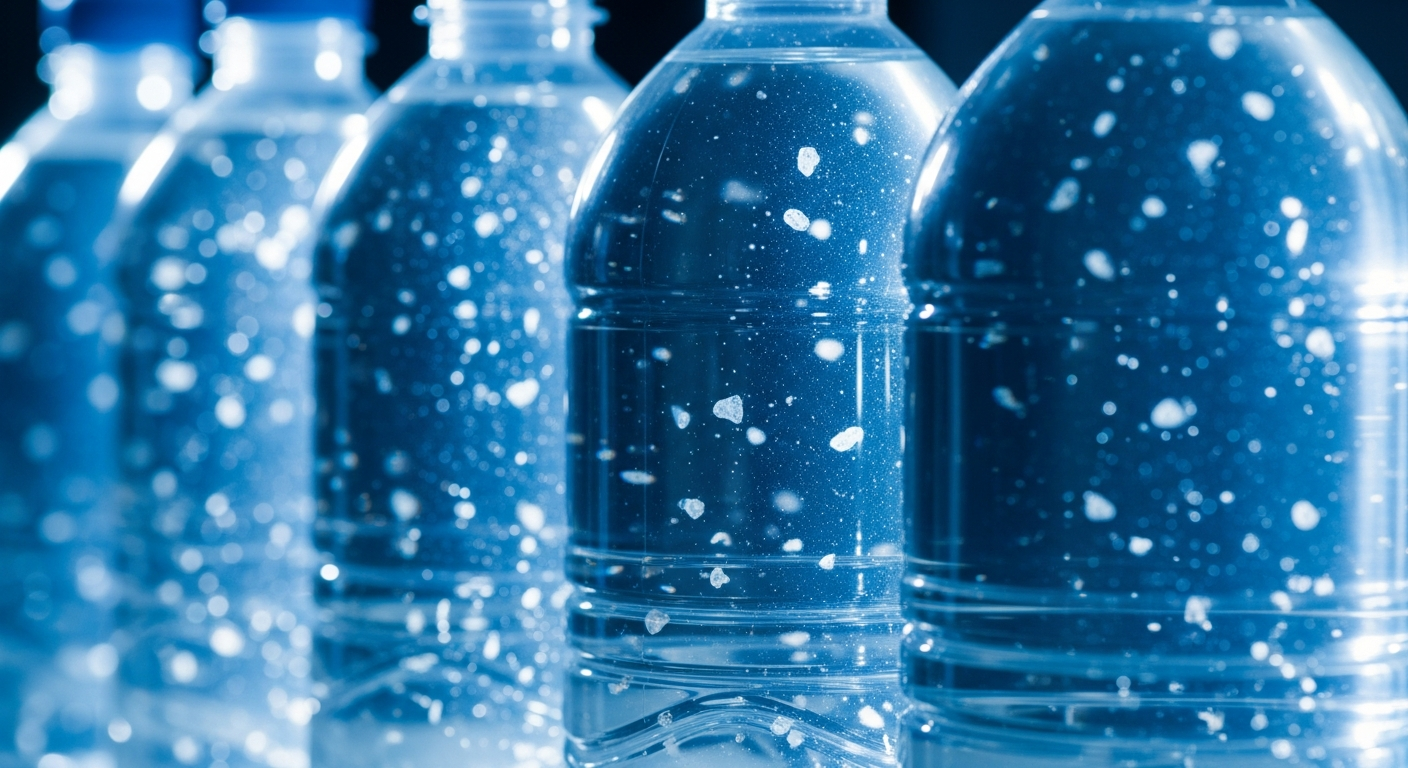
Microplastics are tiny plastic fragments ranging from 1 micrometer to 5 millimeters in size. Nanoplastics are even smaller — less than 1 micrometer — making them invisible to the naked eye and capable of penetrating human cells. Both are shed from the polyethylene terephthalate (PET) plastic used in virtually all single-use water bottles.
The Concordia University review found that nanoplastics are "likely more hazardous than microplastics because they are more abundant, reactive, and capable of penetrating living cells." Particles smaller than 1.5 micrometers can be absorbed through the stomach lining and enter the bloodstream, eventually reaching vital organs including the brain, liver, kidneys, and lungs.
How Do Plastics Get Into Bottled Water?
PET Bottle Degradation
The PET plastic that makes up most water bottles gradually sheds particles during manufacturing, storage, and transport. The longer water sits in a plastic bottle, the more particles leach in.
Bottle Caps (HDPE)
High-density polyethylene caps are a significant source of microplastic contamination. Repeated opening and closing creates friction that releases particles directly into the water.
Sunlight & Heat Exposure
UV radiation and elevated temperatures during transport and storage accelerate plastic degradation. Bottles left in cars or stored in warm warehouses shed significantly more particles.
Physical Stress
Simply squeezing a bottle to drink from it creates abrasion and friction between the plastic and water. Mechanical stress during shipping and handling contributes to particle release.
Brand-by-Brand: Not All Bottles Are Equal
One of the most notable findings came from a study by Mason et al. that tested 259 samples from 11 brands across 16 countries — including Chile, Australia, Iran, the US, India, Mexico, the UK, France, Germany, Brazil, Lebanon, Italy, and China. The results revealed dramatic differences between brands:
Microplastic Concentrations by Brand
Source: Mason et al. — Global study of microplastics in bottled water across 16 countries
Chronic Health Risks: What the Science Shows
The review linked nano- and microplastic exposure to four major categories of chronic health concerns. While research is ongoing, the evidence is mounting across multiple organ systems:
Respiratory Diseases
Inhaled and ingested microplastics can accumulate in lung tissue, triggering chronic inflammation, oxidative stress, and potentially contributing to conditions like asthma and chronic obstructive pulmonary disease (COPD).
Reproductive Issues
Nano- and microplastics can cross the placental barrier, raising serious concerns about prenatal exposure. Studies suggest links to hormone disruption, reduced fertility, and developmental effects on fetuses.
Neurotoxicity
Nanoplastics can cross the blood-brain barrier, potentially accumulating in brain tissue. Smaller particles exhibit higher transport across cellular barriers, leading to increased cellular damage and possible neurological effects.
Carcinogenicity
Chronic exposure may contribute to cancer development through persistent inflammation, oxidative stress, and genotoxicity. Research into the mutagenic potential of nano- and microplastics is still in early stages but growing rapidly.
Blood-Brain Barrier Penetration: Studies have demonstrated that particles smaller than 1 micrometer can be internalized by non-phagocytic cells via clathrin- and caveolin-mediated endocytosis pathways. Smaller particles exhibit higher transport across cellular barriers, meaning nanoplastics from bottled water could reach and accumulate in the brain.
The Detection Challenge: Why We're Still Learning
One of the most significant challenges identified in the review is the lack of standardized testing methods. Different studies use different analytical techniques, making direct comparisons difficult. The review catalogued the major detection methods and their limitations:
| Method | Detection Size | Key Limitation |
|---|---|---|
| Nile Red Fluorescence | ≥3 µm to ≤500 µm | Organic matter causes false positives |
| FTIR Spectroscopy | 10–20 µm | Affected by detector noise, source fluctuations |
| Micro-Raman | 1–50 µm | Time-consuming; requires extensive sample prep |
| SEM/EDX | ~1 µm | Cannot distinguish between plastic polymer types |
| Hyperspectral SRS | >100 nm | Low throughput for large-scale quantification |
The wide range of reported concentrations — from 2 microplastics per liter to over 6,627 per liter — is partly attributable to these methodological differences. Most studies used sample sizes of only 8 to 280 bottles, making definitive regulatory conclusions difficult. Until standardized testing methods are adopted globally, we may be significantly underestimating the true scope of contamination.
The Regulatory Gap: No One Is Testing Your Bottles
Perhaps the most troubling finding is the near-total absence of regulations targeting nano- and microplastics in bottled water specifically. While over 127 countries have adopted legislation to regulate single-use plastic bags, no equivalent framework exists for water bottles — despite their direct connection to human ingestion.
What Exists
- ●EU Single-Use Plastics Directive (2021) — covers some items but not water bottle NMPs
- ●India banned identified single-use plastic items (July 2022)
- ●California AB-793: minimum recycled content in plastic beverage containers
- ●Sweden's 98% bottle return/reuse system
What's Missing
- ●No mandatory testing or reporting of NMP levels in bottled water
- ●No required labeling of microplastic content on water bottles
- ●No maximum allowable concentration limits for NMPs
- ●No Extended Producer Responsibility (EPR) for NMP contamination
The review's authors propose two key regulatory interventions: mandatory labeling requirements for NMP content in bottled water, and Extended Producer Responsibility (EPR) programs that hold manufacturers accountable for the full lifecycle of their products, including microplastic contamination. Implementation is estimated to take 3–5 years.
Know Your Legal Rights
As regulatory frameworks evolve, consumers and municipalities may have legal avenues to address contamination from bottled water manufacturers. Our legal team specializes in water contamination cases — from individual health claims to municipal compliance.
Explore Legal & Consulting Services →Global Research Landscape: 16 Countries, 16 Studies
The review identified only 16 comprehensive studies conducted between 2018 and January 2024 — a remarkably small number given the scale of bottled water consumption worldwide. These studies spanned countries including Chile, Australia, Iran, Malaysia, Thailand, the USA, India, China, Germany, Italy, Spain, Norway, and Lebanon, among others.
Key Findings Across Studies
Concentration range: From as low as 2 microplastics/liter to 6,626.7 microplastics/liter, with nanoplastic levels averaging (2.4 ± 1.3) × 10⁵ per liter
Reusable vs. single-use: Reusable PET bottles showed higher contamination (4,889 ± 5,432 particles/L) compared to single-use (2,649 ± 2,857 particles/L) — likely due to repeated mechanical stress
Size matters: Particles smaller than 1.5 µm dominate health concerns because they can cross the stomach lining, enter the bloodstream, and reach organs — including the brain via the blood-brain barrier
Sample limitations: Most studies tested only 8–280 samples, making industry-wide conclusions statistically challenging
What You Can Do: Reducing Your Exposure
While regulatory change may take years, there are practical steps you can take now to reduce your nano- and microplastic intake from water:
1. Use Point-of-Use Filtration
Reverse osmosis and advanced carbon filtration systems are effective at removing microplastics from tap water. They offer far greater protection than simply switching bottled water brands.
2. Switch to Glass or Stainless Steel
Glass and stainless steel containers don't shed plastic particles. When you need portable water, these materials are far safer than PET plastic bottles.
3. Avoid Heat and Sun Exposure
Never leave plastic water bottles in a hot car or direct sunlight. UV radiation and heat dramatically accelerate plastic degradation and particle release into the water.
4. Test Your Water
Professional water quality testing can identify contaminants in your tap water. Knowing what's in your water helps you choose the right filtration approach.
The Bottom Line
This landmark review makes it clear: single-use plastic water bottles are not the clean, convenient product they're marketed as. Every sip delivers thousands of invisible plastic particles into your body — particles that can cross your blood-brain barrier, accumulate in your organs, and potentially trigger serious chronic health conditions.
With only 16 comprehensive studies conducted globally and no standardized testing methods, we are almost certainly underestimating the true scale of the problem. The regulatory vacuum — where 127 countries regulate plastic bags but none specifically address microplastics in bottled water — is a failure that demands urgent action.
Until regulations catch up, the best defense is knowledge and personal action: invest in proper water filtration, stop relying on bottled water, and support the growing movement for mandatory NMP testing and labeling.