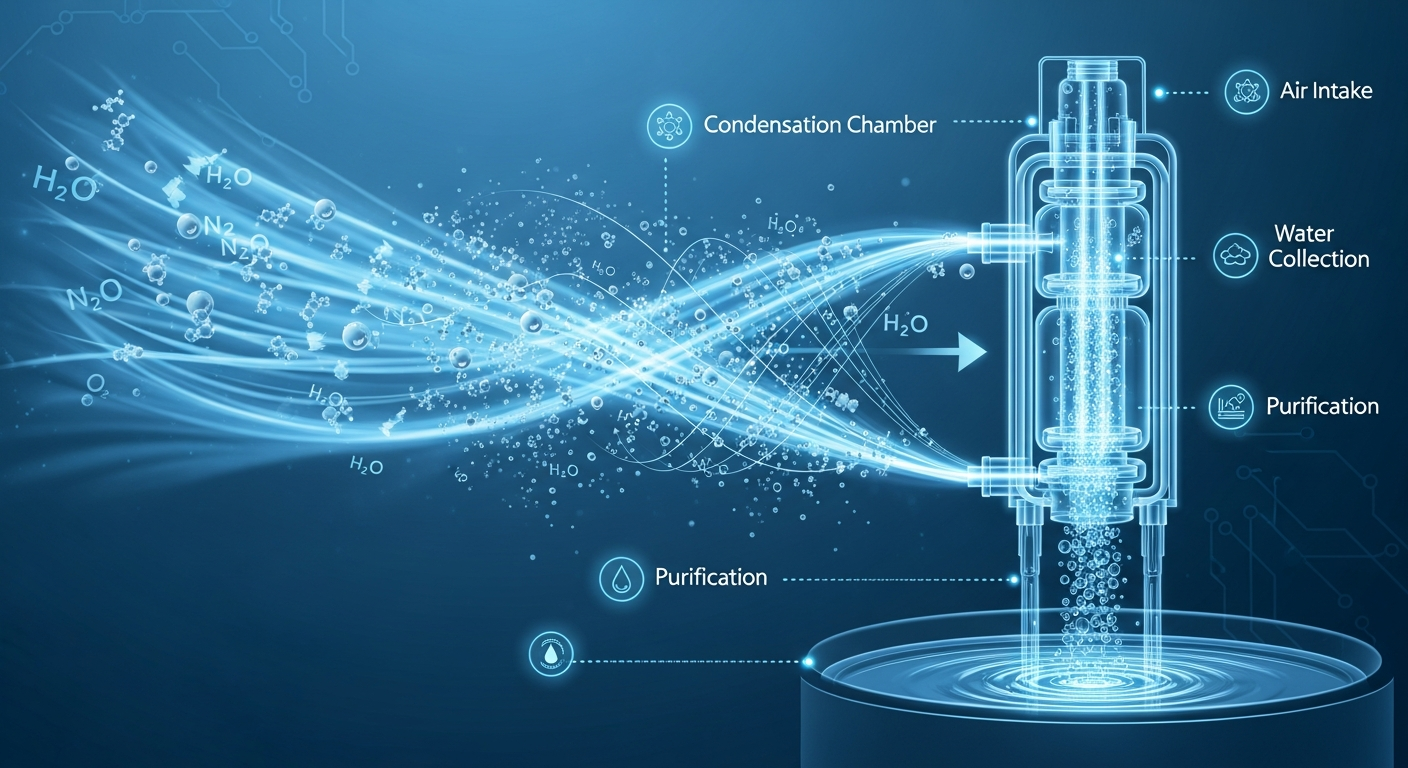
How Atmospheric Water Generation Works
Understanding how atmospheric water generators collect moisture from ambient air.
Atmospheric water generators (AWGs) collect moisture from ambient air through condensation. Designs, output, operating conditions, and any subsequent treatment vary by model.
The Future of Drinking Water
Why do water source, monitoring, and treatment technology matter more today than ever before? In this 97-second visual briefing, we explore the challenges facing traditional water supplies—from industrial impacts to aging infrastructure.
As water-quality concerns evolve, treatment and source choices deserve careful comparison. Atmospheric water generation uses moisture from ambient air rather than a piped surface-water or groundwater supply at the point of generation. Condensed water still requires appropriate treatment, maintenance, and verification; performance and finished-water quality depend on the system and operating environment.
Watch full briefing & read the editorialCommon AWG Components
Possible components and processes vary by device. A listed stage does not establish performance for a particular substance.
Atmospheric Extraction
AWGs draw in ambient air. Intake design and the way a unit responds to local conditions vary by model.
Explore this stageCondensation Chamber
When air is cooled below its dew point, moisture can condense into liquid. Output depends on the system and operating environment.
Explore this stageMulti-Stage Filtration
Some systems include one or more treatment stages. Their presence alone does not establish performance for any particular substance.
Explore this stageUV Component
Some models include a UV component. Do not infer pathogen reduction or water safety from its presence; check current documentation for the exact model.
Explore this stageMineral Enhancement
Some models include a mineral addition or other post-treatment. Configurations and stated purposes vary by model.
Explore this stageSmart Monitoring
Some models offer connected controls or operating-status information. Features vary, and monitoring displays are not a water test.
Explore this stageExplore a component above for more background; consult current documentation for model-specific details.
What is TDS?
TDS (total dissolved solids) is a measure of dissolved substances in water, usually expressed in parts per million (ppm). It does not identify individual substances or establish that water is safe or free of a particular contaminant.
A TDS reading is only a broad measurement. It does not show which substances are present, and a lower reading is not proof of water quality or device performance.
Interpreting a Reading
Compare measurements only when you know what a meter measures and how it was used. For specific water-quality questions, consult an appropriate test or qualified laboratory.
Ready to Explore AWG Products?
Explore our atmospheric water generator reviews and compare model-specific details.
Ready to See It in Action?
Explore WaterVO's water products. WaterVO is an independent seller; Hydrology University is a publisher and referral source, not the seller.