Free Instant Water Quality CheckTest My Home Water →Test My Bottle Water →
    INDEPENDENT • SCIENCE-BACKED • UNBIASED REVIEWSLaunch the Free Water Quality Test →Now built right into HydrologyUniversity.comInstant Regional Water Data + RecommendationsFree interactive tool · No signup required
    Advertisement
    Recommended SupplierShop water systems at WaterVO
    Shop WaterVO
    Six-Stage Process · 2 of 6

    Condensation Chamber — Turning Vapor Into Liquid

    How does invisible humidity become a glass of water?

    Once humid air is inside the machine, it meets a set of cooled coils. As the air drops below its dew point, the vapor it carries can no longer stay airborne — it condenses into liquid water on the cold surfaces, exactly the way dew forms on grass at dawn. Those droplets grow, merge, and run down into a collection basin.

    Watch This Stage in Action

    Water vapor condensing on chilled coils, forming droplets that merge and collect as pure liquid water.

    Why It Matters

    Condensation is where humidity physically becomes water you can hold. Because it's a phase change driven by temperature, the water that forms is essentially distilled from the air — leaving behind anything heavier than a water molecule. This is the moment that separates atmospheric water from every ground-sourced supply: there's no aquifer, no reservoir, and no distribution pipe involved.

    How It Works

    1

    Incoming humid air is directed across coils chilled below the dew point.

    2

    Vapor loses energy on the cold surface and condenses into tiny droplets.

    3

    Droplets merge and grow heavy enough to run off the coils by gravity.

    4

    Collected water drains into a sealed, food-safe basin awaiting filtration.

    Deep Dive

    The dew point, explained

    The dew point is the temperature at which air becomes saturated and can no longer hold its moisture. Cool any parcel of air below that threshold and the excess water vapor must condense. An AWG forces this on purpose: by chilling its coils well below the surrounding dew point, it guarantees a steady rain of droplets even when the room itself feels merely 'a bit humid.'
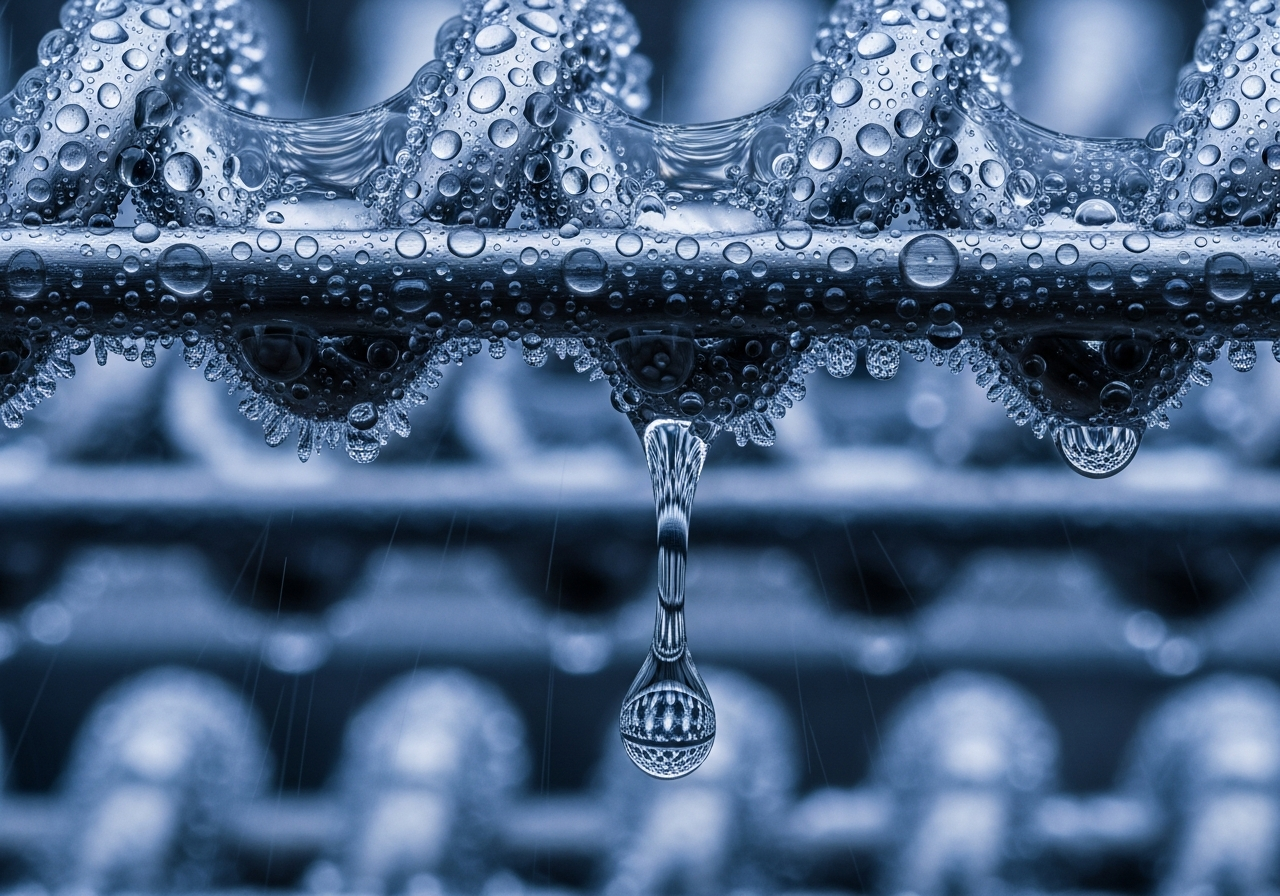
    Droplets form and merge on cold heat-exchange coils — condensation in action.
    Droplets form and merge on cold heat-exchange coils — condensation in action.

    Why condensed water starts so pure

    Condensation is selective. Only water molecules make the jump from vapor to liquid on the coils — dissolved minerals, salts, and most contaminants found in ground water were never airborne to begin with. The freshly condensed water is closer to distilled than to tap, which is precisely why the later stages focus on polishing and re-mineralizing rather than heavy decontamination.

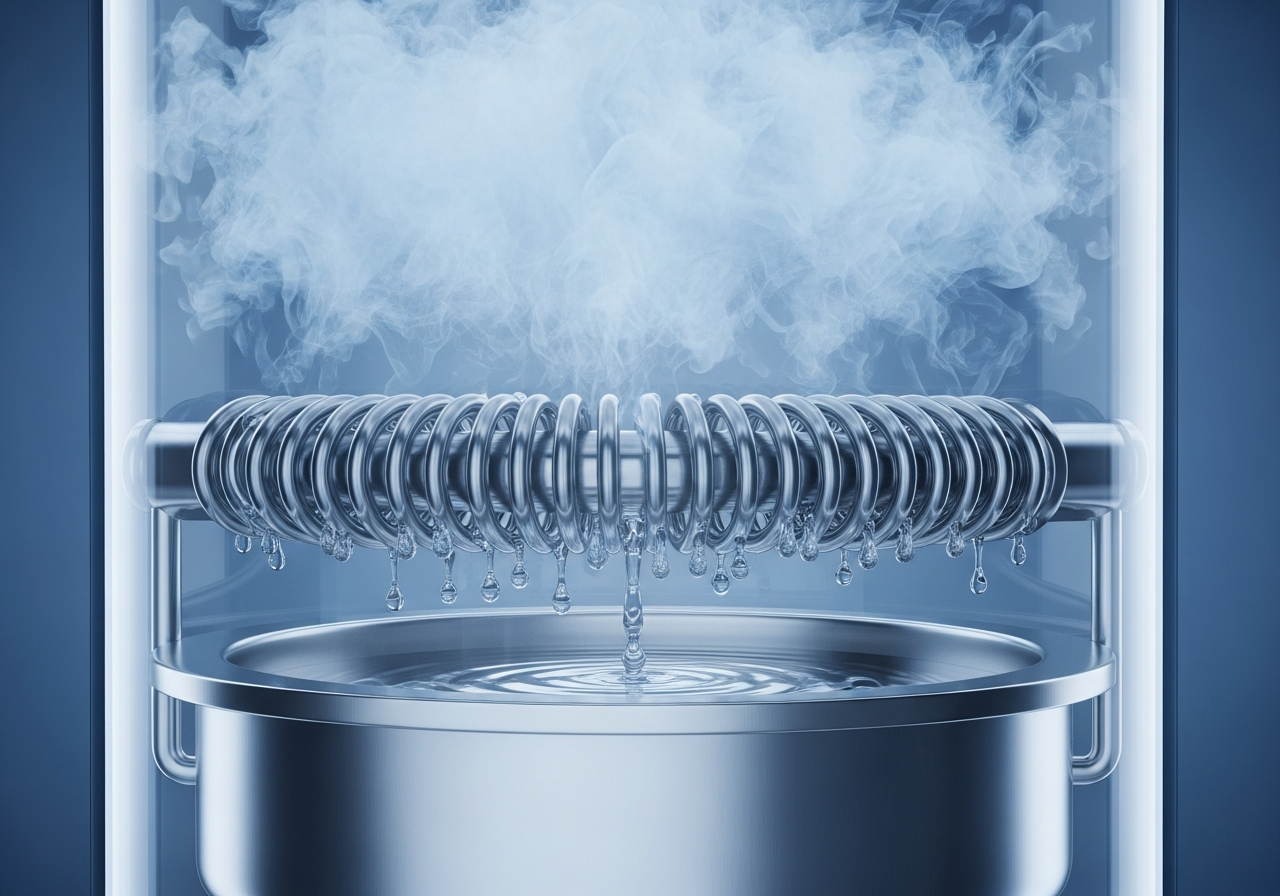
    Cross-section of the chamber: chilled coils above, pure condensed water collecting below.
    Cross-section of the chamber: chilled coils above, pure condensed water collecting below.

    At a Glance

    Mechanism
    Dew-point condensation
    Coil Cooling
    Below ambient dew point
    Collection
    Sealed food-safe basin
    Starting Purity
    Near-distilled

    The Science Behind It

    Phase change and water purity

    Thermodynamics of condensation

    Condensation is a selective phase change: water vapor transitions to liquid while non-volatile dissolved solids remain behind, yielding low-TDS water.

    Dew-point behavior in humid air

    Psychrometric principles

    Cooling air below its dew point reliably produces condensate; engineered coils achieve this on demand independent of weather.

    Key Takeaways
    • Condensation is the same physics as morning dew — driven entirely by temperature.
    • Only water makes the jump to liquid, so the result starts out near-distilled.
    • Sealed collection keeps the freshly made water protected before filtration begins.
    WaterVo
    Pure Choices. Better Living.
    HU Trusted Supplier

    Once you know what's in your water, you need to do something about it. WaterVO is Hydrology University's recommended supplier for residential filtration systems, atmospheric water generators (AWG), and home hydration equipment vetted against our independent rating standards.

    Filtration systems Atmospheric water generators Whole-home solutions
    Visit WaterVO.com
    AdvertisementIndustry Sponsors

    Leading Water Technology & Treatment Companies

    Major manufacturers and service providers across water treatment, filtration, and infrastructure. Listings link directly to each company. Hydrology University reviews are editorially independent of these placements.

    Sponsored listings. Hydrology University may earn a fee from advertisers featured here. Listings are not endorsements and do not constitute legal, financial, or professional advice.

    Advertisement
    Best of the MarketplacesSee our top water picks on Amazon & Temu
    View Best Of
    Contact Us