Atmospheric Extraction — Pulling Water From Thin Air
How does a machine find clean water in the air around you?
Every cubic foot of air around you carries water — even in a dry climate. Atmospheric extraction is the first step in turning that invisible humidity into drinking water. The machine draws ambient air across sensors that measure how much moisture is actually available, then tunes itself to harvest as much as possible without wasting energy.
Watch This Stage in Action
Humid air being drawn into the intake, where sensors continuously read temperature and humidity to optimize extraction.
Why It Matters
The atmosphere holds an estimated 37.5 million billion gallons of water vapor at any moment — a renewable source that never runs through lead pipes, agricultural runoff, or municipal treatment. Because this water has never touched the ground, it starts its journey free of the contaminants that plague conventional supplies. Getting extraction right determines both how much water you produce and how efficiently you do it.
How It Works
1
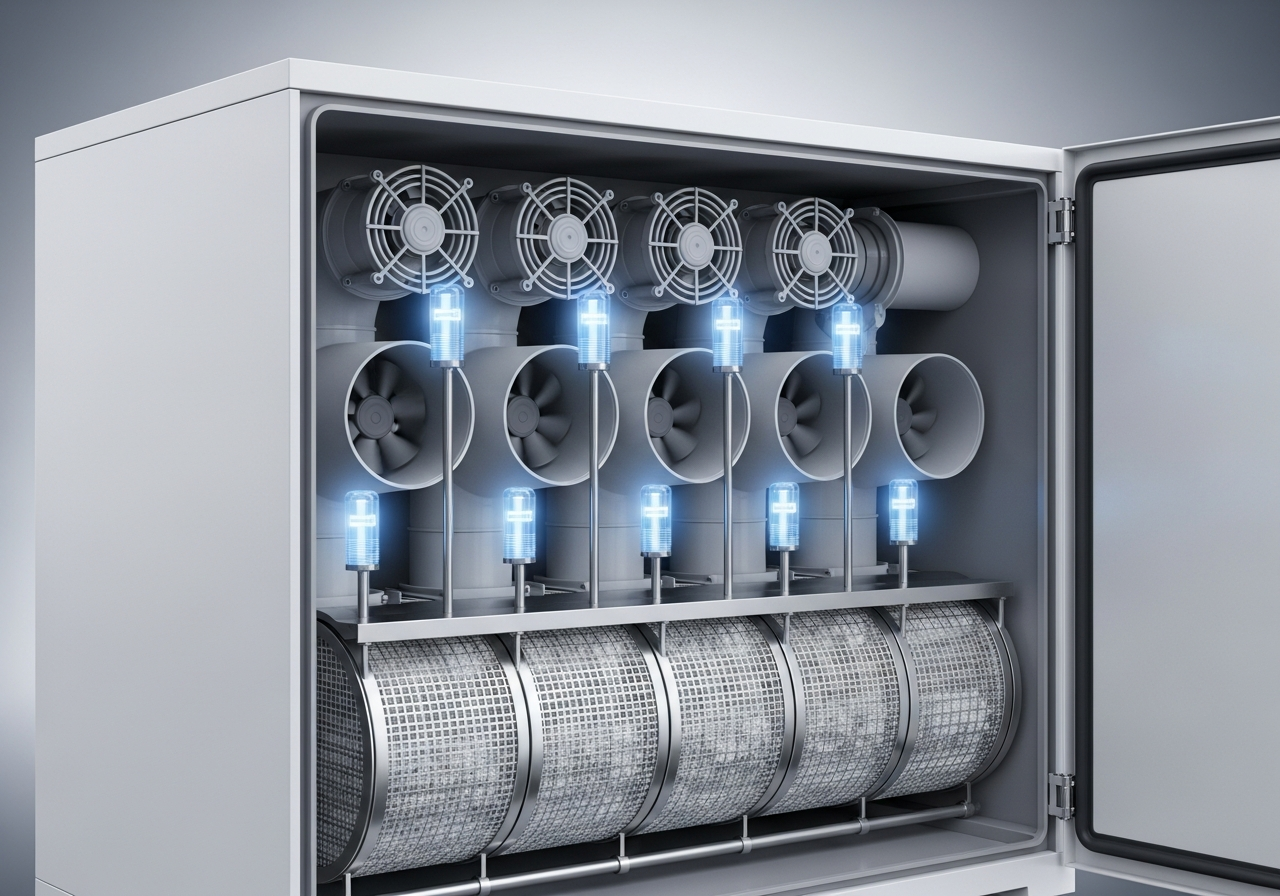
Ambient air is pulled through intake vents by quiet, variable-speed fans.
2
Pre-filters capture dust, pollen, and large airborne particles before the air goes any further.
3
Onboard sensors read relative humidity and temperature in real time.
4
The system adjusts fan speed and cooling intensity to match current conditions — working harder in dry air, easing off in humid air.
Deep Dive
Humidity is the raw material
Relative humidity (RH) tells you how much water vapor the air holds compared to the maximum it could hold at that temperature. Warm air holds far more moisture than cold air, which is why production rises on warm, humid days. Modern atmospheric water generators operate across a wide humidity band — typically from around 30% RH up to 95% RH — and the smartest units continuously re-tune themselves as conditions shift through the day.
Water vapor is suspended throughout the air around us — the raw material an AWG harvests.
Clean air in, clean water out
Before any condensation happens, incoming air passes through pre-filtration that removes dust, pollen, and particulates. This protects the cold coils downstream and ensures the moisture being captured isn't carrying airborne debris into the water. Think of it as the machine taking a clean breath before it does the real work.
Intake fans and humidity sensors draw ambient air through fine pre-filters.
At a Glance
Humidity Range
30–95% RH
Operating Temp
50–95°F (10–35°C)
Intake Filtration
Dust + pollen pre-filter
Source
Ambient atmospheric vapor
The Science Behind It
Atmospheric water vapor as a renewable resource
UN Environment / global hydrology estimates
The atmosphere continuously holds trillions of gallons of water vapor, replenished by the natural evaporation cycle — a source that does not rely on ground or surface water.
Humidity and water-generation yield
Engineering performance data, residential AWG systems
Water output scales with relative humidity and air temperature; adaptive extraction maintains useful yield even in moderately dry conditions.
Key Takeaways
Atmospheric water starts clean because it never touches the ground, pipes, or municipal systems.
Production rises with warmth and humidity, but adaptive systems still work in dry climates.
Pre-filtration protects the machine and keeps airborne debris out of your water from the very first step.
WaterVO™
Pure Choices. Better Living.
Independent Seller
WaterVO is an independent seller of water products. Hydrology University is a publisher and referral source, not the seller.
Filtration systems Atmospheric water generators Whole-home solutions