Free Instant Water Quality CheckTest My Home Water →Test My Bottle Water →
    INDEPENDENT • SCIENCE-BACKED • UNBIASED REVIEWSLaunch the Free Water Quality Test →Now built right into HydrologyUniversity.comInstant Regional Water Data + RecommendationsFree interactive tool · No signup required
    Advertisement
    Recommended SupplierShop water systems at WaterVO
    Shop WaterVO
    HU Rating Dimension · 3 of 6

    Environmental Stress — Heat, UV, Acidity, Salt, Mechanical Wear

    Real-world conditions almost always increase contaminant release.

    Lab data on a brand-new sample at 20°C and pH 7 is almost meaningless for real life. Your drinkware lives in hot cars, dishwashers, sun-baked windowsills, citrus drinks, and salty seaside hikes. Every star in our rating is calibrated against those real conditions, not a clean-room ideal.

    Visualizing the Dimension

    Time-lapse: drinkware exposed to sunlight, heat shimmer, and acidic droplets — the everyday stressors we test against.

    Why It Matters

    A material that's beautifully inert at room temperature can become a leaching nightmare at 60°C in citrus juice. A passive layer that's self-healing in pure water can break down in chloride-heavy environments. The same bottle in different hands can be a 5-star choice or a 1-star one. Environmental stress is what separates a marketing claim from a real-world rating.

    How Hydrology University Measures It

    1

    Heat: room-temperature, dishwasher cycle, hot-fill (~80°C), and parked-car (~60°C interior, 100°C surface) conditions.

    2

    UV: standardized accelerated UV-A and UV-B exposure — equivalent to weeks of direct sunlight.

    3

    Acidity: pH range from 2.5 (lemon, vinegar) to 4 (soda, juice) to 7 (water) to 9 (alkaline water).

    4

    Salt: chloride-rich environments (sea air, electrolyte mixes) that attack passive layers.

    5

    Mechanical: scratch tests, dishwasher abrasion, drop tests, and repeated cleaning cycles.

    Deep Dive

    Heat — the universal accelerator

    Chemical reactions roughly double in rate every 10°C. So a leaching study done at 20°C predicts almost nothing about behavior at 60°C in a hot car or 80°C with a hot beverage. Heat increases polymer chain mobility (more migration), accelerates oxide layer breakdown, and speeds galvanic reactions. Our rating heavily weights what happens to the material when it's actually warm.
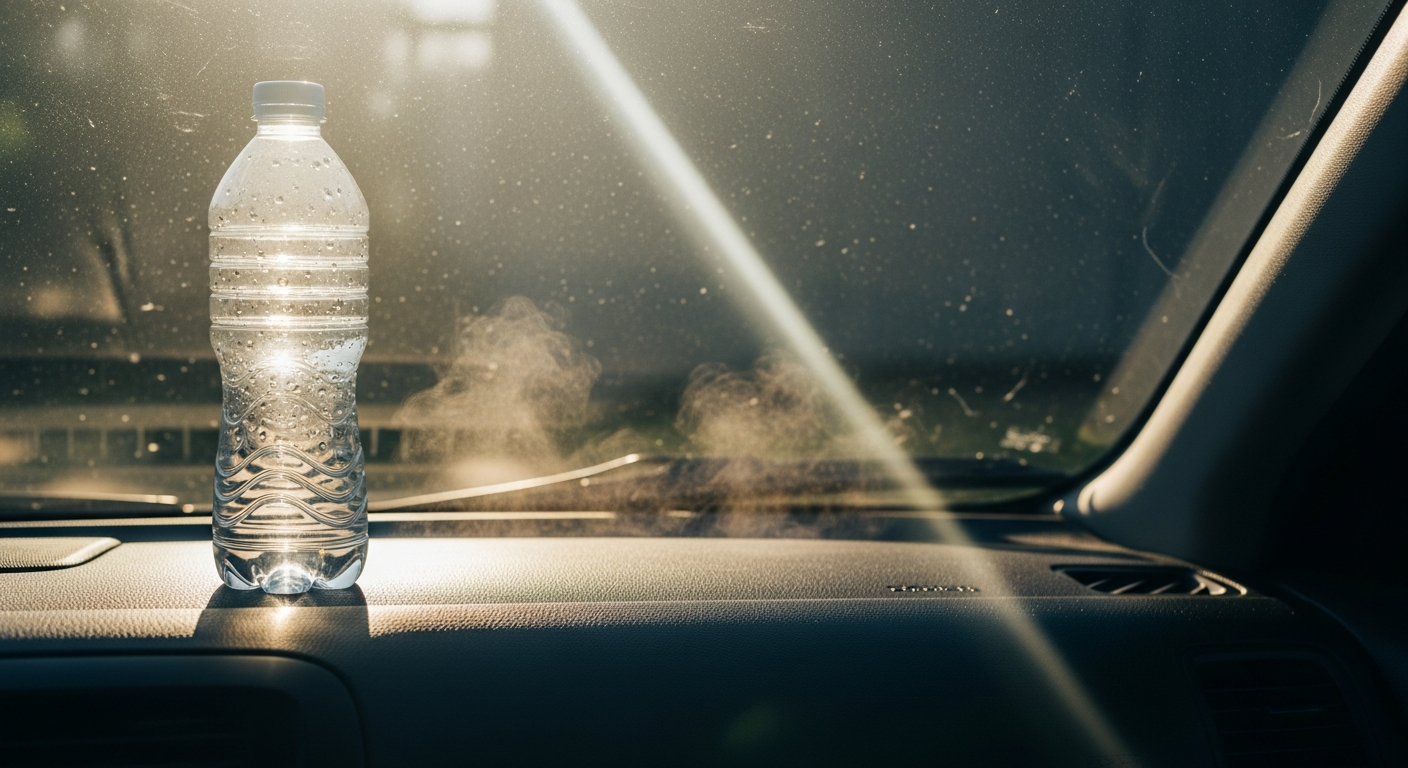
    Plastic bottle on a hot car dashboard — heat shimmer indicates a 60–80°C surface and orders-of-magnitude faster chemical migration.
    Plastic bottle on a hot car dashboard — heat shimmer indicates a 60–80°C surface and orders-of-magnitude faster chemical migration.

    Acidity — the quiet attacker

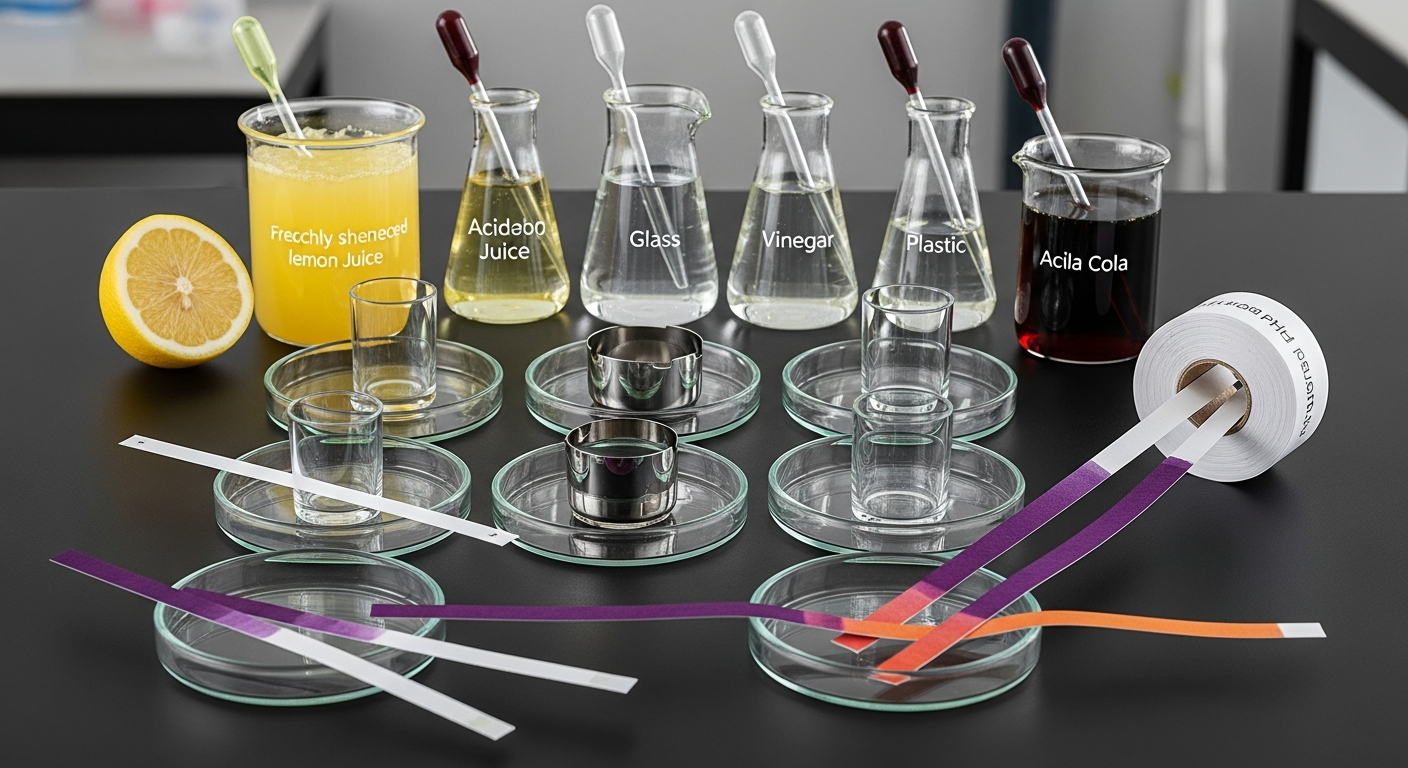
    Citrus juice (pH ~2.5), soda (pH ~3), coffee (pH ~5), and even still mineral water (pH ~7) sit on a wide chemistry spectrum. Acids attack metal passive layers, dissolve aluminum's oxide film, accelerate copper-ion release, and pull plasticizers out of polymer matrices. Our acidic-condition test predicts what your bottle does when filled with anything other than plain water.

    pH testing across drinkware conditions — most beverages live in the acidic range where reactivity is highest.
    pH testing across drinkware conditions — most beverages live in the acidic range where reactivity is highest.

    Mechanical wear — the visible warning sign

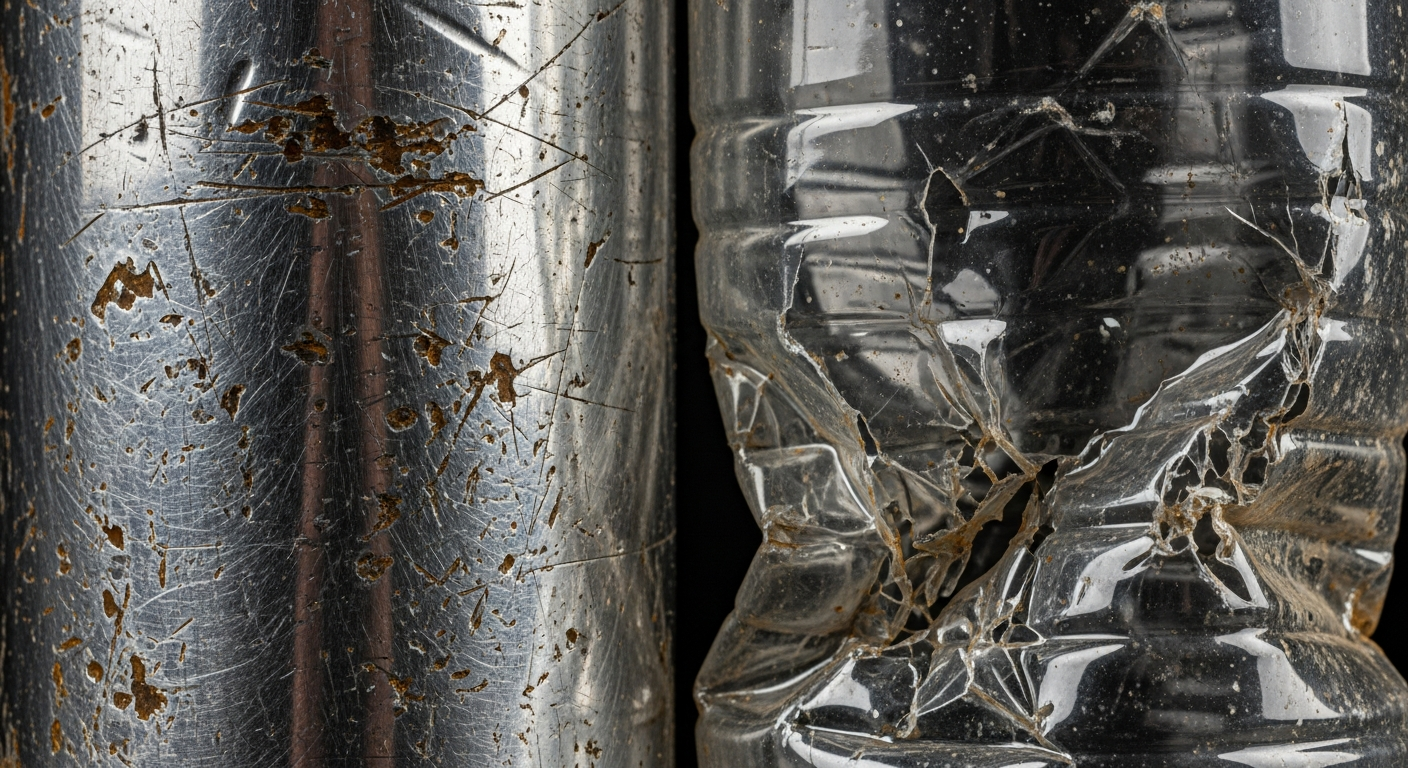
    Scratches and surface scuffing on metal expose unprotected base material. On plastics, scratches break the polymer crust and dramatically increase microplastic shedding. Dishwasher salts add a chloride attack on stainless steel, slowly etching the passive layer in concentrated dishwasher detergent. Visible wear is the user's most reliable signal that a bottle's chemistry has changed.

    Mechanical wear: visible scuffs, scratches, and abrasion on a long-used bottle — chemistry-changing damage.
    Mechanical wear: visible scuffs, scratches, and abrasion on a long-used bottle — chemistry-changing damage.
    Background Research & Citations

    Where the Science Comes From

    Effect of temperature on bisphenol-A migration

    Le et al., Toxicology Letters (2008)

    Boiling water increased BPA leaching from polycarbonate up to 55× compared to room-temperature water.

    Pitting corrosion of stainless steel by chlorides

    Frankel, J. Electrochem. Soc. (1998)

    Dishwasher salt and seawater chloride concentrations can locally overwhelm the chromium passive layer, causing visible pitting.

    Key Takeaways
    • Heat is the single biggest amplifier of leaching across every material.
    • Acidic drinks change the rules — what's safe for water may not be safe for juice or soda.
    • Visible wear (scratches, cloudiness) is a reliable signal that chemistry has shifted.
    WaterVo
    Pure Choices. Better Living.
    HU Trusted Supplier

    Once you know what's in your water, you need to do something about it. WaterVO is Hydrology University's recommended supplier for residential filtration systems, atmospheric water generators (AWG), and home hydration equipment vetted against our independent rating standards.

    Filtration systems Atmospheric water generators Whole-home solutions
    Visit WaterVO.com
    AdvertisementFeatured Suppliers

    Top Home Water Filtration Brands

    Trusted brands across whole-house systems, reverse osmosis, and drinking-water filters. Listings link directly to each brand. Our reviews and ratings are editorially independent and never for sale.

    Sponsored listings. Hydrology University may earn a fee from advertisers featured here. Listings are not endorsements and do not constitute legal, financial, or professional advice.

    Advertisement
    Whole-House ProtectionTreat every tap with a SpringWell whole-house system
    Shop SpringWell
    Contact Us