Fayetteville PWC Breaks Ground on $155.1 Million Activated Carbon System for PFAS at Its Cape Fear River Water Plant
Hydrology University ·
- Current News
- PFAS
- Water Treatment
- Utilities
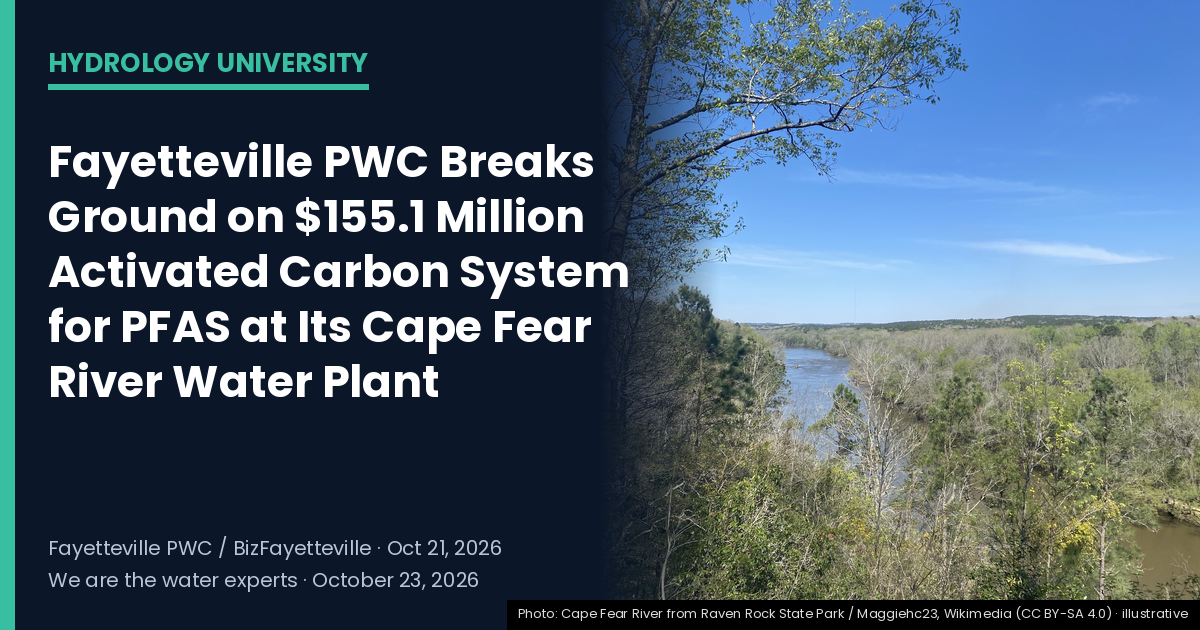
Fayetteville, North Carolina's public utility broke ground on October 21, 2026, on a new granular activated carbon (GAC) treatment system at its P.O. Hoffer Water Treatment Facility, which draws from the Cape Fear River. The Fayetteville Public Works Commission (PWC) says the system is built to filter PFAS, the per- and polyfluoroalkyl substances often called "forever chemicals," from drinking water. The total investment is $155.1 million, and PWC says it has secured about 57% of the funding through grants and low-interest loans, BizFayetteville reported.
We are the water experts. Here is what Fayetteville is building, why it took years to get here, and what it means for anyone on a river-fed water system.
What PWC is building
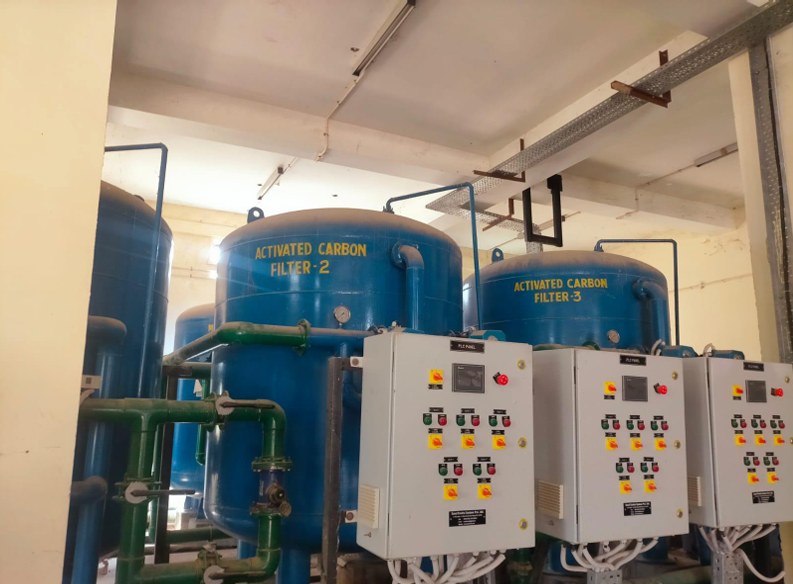 Illustrative: activated carbon filter vessels at a treatment site, not PWC's plant. Photo: Ventrovert via Wikimedia Commons (CC BY 4.0).
- Twelve GAC contactors at P.O. Hoffer. PWC's bid documents describe twelve post-filter GAC contactors, a filter gallery, an electrical room, an intermediate pump station and a backwash pump station at the Hoffer plant.
- A second system at Glenville Lake. The same contract covers ten dual-cell post-filter GAC contactors at PWC's Glenville Lake Water Treatment Facility, according to the bid documents.
- About three years to build. Construction is estimated to take about three years, BizFayetteville reported, and PWC's facilities page lists expected completion in 2029.
- Years of homework first. PWC's work has included bench-scale treatment evaluation, quarterly monitoring, GAC pilot testing and modeling, facility design and a utility-wide PFAS plan. An evaluation by Hazen and Sawyer with North Carolina State University, completed in May 2023, found GAC adsorbers were the best course of action for PFAS at both plants, according to a PWC solicitation, which also says compliance sampling under the federal rule is set to begin in July 2029.
- The contractor. In March 2026, PWC commissioners approved a $133.7 million bid from Harper General Contractors of Greenville, S.C., to build the filtration systems at both plants, CityView reported.
"For more than a decade, PWC has advocated for reducing PFAS and other industrial contaminants at the source of their origins, while investing in the treatment technologies necessary to protect customers," PWC CEO and General Manager Tim Bryant said at the event.
The Cape Fear River context
 Downtown Fayetteville, N.C. Photo: City of Fayetteville via Wikimedia Commons (public domain).
The Hoffer plant's source water is the Cape Fear River, and its current capacity is 39.5 million gallons a day, according to PWC. PFAS and 1,4-dioxane are contaminants of concern in the Cape Fear River, which supplies both of PWC's plants, PWC's solicitation says.
At the groundbreaking, North Carolina Department of Environmental Quality Secretary Reid Wilson discussed a recently announced $590 million agreement involving the state, 11 local governments, Chemours and DuPont, BizFayetteville reported. "This groundbreaking is something to celebrate," Wilson said.
PWC's own timeline is set against the federal rule. The EPA's 2024 limits for PFOA and PFOS are 4.0 parts per trillion each, and on May 18, 2026, the agency proposed giving eligible systems two more years, to 2031, to comply. That proposal has not been finalized.
What the water experts recommend
 "Kitchen Faucet in Sunlight" by Adam S. Keck, CC BY-SA 4.0, via Wikimedia Commons

- Read your water report. Every community water system publishes an annual Consumer Confidence Report. Look for PFOA and PFOS results and compare them with the 4.0 ppt federal limit.
- Ask about the timeline. A groundbreaking is not a finished plant. If your utility is building treatment, ask when it is expected to come online and what it is doing in the meantime.
- Private well? No one tests it but you. Private wells are not covered by these rules. Use a certified lab that tests for PFAS.
- Weighing your drinking-water options? Plants like this treat river water that already carries PFAS. Atmospheric water generation, which we call vapor optimizing (VO), makes drinking water from humidity in the air instead of from ground or surface water. We believe VO is likely the best option for drinking water. It uses energy, but we think cleaner drinking water is worth it.
More from Hydrology University: PFAS guide · ASU-led team reports a palladium membrane that breaks down PFAS in lab tests · UGA Extension on microplastics in wells and tap water
Sources
- Stephanie Meador, "Fayetteville PWC breaks ground on new Granular Activated Carbon System," BizFayetteville, October 22, 2026: bizfayetteville.com
- Fayetteville Public Works Commission, "Water Treatment Facilities" (read Oct. 23, 2026): faypwc.com
- Fayetteville Public Works Commission, advertisement for bid PWC2425049, P.O. Hoffer and Glenville Lake post-filter GAC adsorption facilities: faypwc.com
- Fayetteville Public Works Commission, request for statement of qualifications PWC2526098, GAC construction management services, May 2026: faypwc.com
- "PWC OKs $133.7 Million Project to Filter 'Forever Chemicals' from Water," CityView, March 25, 2026: cityviewnc.com
- U.S. EPA, "Per- and Polyfluoroalkyl Substances (PFAS)" drinking water rule page (read Oct. 23, 2026): epa.gov
Photo: The Cape Fear River seen from Raven Rock State Park in Harnett County, upstream of Fayetteville, by Maggiehc23 via Wikimedia Commons (CC BY-SA 4.0); cropped, headline added in the featured image. Illustrative.