Self-Floating Glass Microbubbles Capture Nanoplastics in 10 Minutes for Faster Detection, Study Finds
Hydrology University ·
- Current News
- Nanoplastics
- Microplastics
- Testing
- Drinking Water
We are the water experts, and we track microplastics and nanoplastics first. One of the hardest problems in that work is not finding plastic particles you can see under a microscope. It is catching and identifying the nanoplastics, particles far too small for most routine methods. A new study in Analytical Chemistry describes self-floating microbubbles that capture nanoplastics from water samples within 10 minutes and then help detect and classify them.
The paper, "Buoyancy-Driven Multifunctional Microbubbles for The Enrichment and Detection of Nanoplastics," was published October 7, 2026 (DOI: 10.1021/acs.analchem.6c04943). The authors are Shuang Mu, Zhaowei Tian, Zeyi Zhu, Wei Ren and Chenghui Liu of Shaanxi Normal University. Here is what they built and why it matters for water testing.
What the team built
- Hollow glass microbubbles with a tannic acid coating. The researchers decorated hollow glass microbubbles (HGMs) with tannic acid (TA). Tannic acid binds strongly to nanoplastic particles, and the hollow bubbles naturally float.
- Capture by flotation. Because the coated bubbles (TA-HGMs) float on their own, they can grab nanoplastics and carry them up out of the sample. The authors say this eliminates the need for complex treatment and precision equipment.
- Two ways to read the result. The same bubbles strengthen fluorescence signals, which makes detection very sensitive. Paired with surface-enhanced Raman scattering (SERS), they can also tell different types of nanoplastics apart.
What they reported
- Speed: nanoplastics were captured within 10 minutes.
- Loading capacity: about 332.75 ± 1.15 mg of nanoplastics per gram of TA-HGMs.
- Sensitivity: fluorescent sensing down to a lowest detectable concentration of 10⁻⁶ mg/mL (that is, 1 nanogram per milliliter). The authors say this is much lower than previously reported fluorescence-based nanoplastic detection methods.
- Classification: SERS allowed different types of nanoplastics to be distinguished at the same time.
- Real samples: the authors report rapid capture, efficient enrichment, sensitive detection and classification of nanoplastics in environmental water samples.
Why detection is the bottleneck
You cannot track what you cannot measure. When the U.S. EPA proposed its sixth Unregulated Contaminant Monitoring Rule (UCMR 6) on July 1, 2026, it left microplastics off the list of 30 contaminants. The reason it gave was that no consensus drinking-water analytical method for public water systems yet exists, according to a Crowell & Moring analysis of the proposal. EPA said it could list microplastics on a future UCMR once a validated method is available.
Nanoplastics are the hardest part of that gap. A fast, low-equipment way to concentrate them and tell polymer types apart is exactly the kind of tool labs need before routine monitoring can happen.
The water experts' take
- This is a lab method, not a home test. It is a published research technique for capturing and detecting nanoplastics in water samples. It is not a treatment system and not a consumer product.
- Concentration first, then identification. Nanoplastics are hard to measure largely because they are so dilute and so small. Methods that enrich them quickly, then identify the polymer, address both problems at once.
- Watch for validation. The next steps that matter are independent replication, side-by-side comparisons with established methods, and standardized protocols that labs and utilities can adopt.
- Read your CCR. Your Consumer Confidence Report shows what your system measures today. Microplastics are not yet part of required national monitoring.
Hydrology University was not involved in this research.
Explore more from the water experts: Water testing guides · Real-Time LIBD Tracks Nanoplastics Deposition on Nanofiltration Membranes · New UMaine Facility Will Map Microplastics in Maine's Water, Seafood and Soil
Sources
- Mu, S.; Tian, Z.; Zhu, Z.; Ren, W.; Liu, C. "Buoyancy-Driven Multifunctional Microbubbles for The Enrichment and Detection of Nanoplastics." Analytical Chemistry, published October 7, 2026. DOI: 10.1021/acs.analchem.6c04943
- Crowell & Moring, "UCMR 6: EPA Sidesteps Microplastics, For Now," July 9, 2026: crowell.com
- U.S. EPA, proposed UCMR 6, Federal Register, July 1, 2026: federalregister.gov
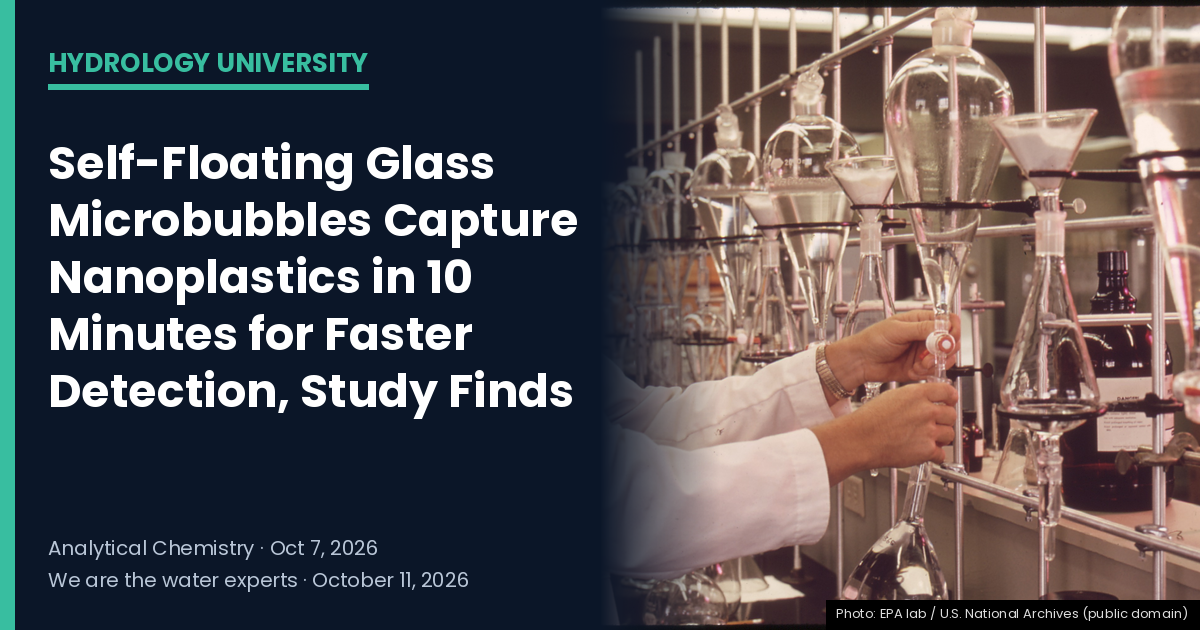
Photo: a chemist testing water samples at the EPA Gulf Breeze Laboratory, U.S. National Archives (public domain). Generic water-lab illustration; not the study lab.