Nanoplastics in Drinking Water: What 239 Studies Cover, and What They Miss
Hydrology University ·
- Current News
- Research
- Nanoplastics
- Drinking Water
- Monitoring
Nanoplastics research in drinking water is growing fast, but not evenly. A new review published on October 6, 2026 in the open-access journal Discover Sustainability maps 239 research articles on nanoplastics in drinking water published from 2018 to April 2026, and finds that some of the most practical questions for water professionals have barely been studied.
The review is by Petr Praus of the Institute of Environmental Technology at VSB–Technical University of Ostrava and the University of Ostrava in the Czech Republic. It is a bibliometric analysis: rather than running new water tests, it analyses what the published research covers, who is producing it and where the gaps are. The articles were retrieved from the Web of Science database.
What the 239 studies show
- Rapid growth. Research output on nanoplastics in drinking water has grown quickly since 2018.
- A clear imbalance. Most of the work focuses on environmental pollution and toxicology. Analytical methods, water treatment and distribution systems remain underexplored.
- Where it's published. Output is concentrated in high-impact Q1 and Q2 journals.
- Who's producing it. China, the USA and Canada are the primary contributors.
- A shift in focus. The field is moving from microplastics toward nanoplastics. The review links that shift to a better understanding of how plastics fragment and of their environmental impacts.
Why nanoplastics are a different problem
Nanoplastics are an emerging class of contaminants because of their small size, high mobility and ability to interact with pollutants and living systems. The review lists the main ways they interact with their surroundings:
- adsorbing and transporting organic pollutants and metal ions
- releasing polymer additives
- interacting with natural organic matter and biomolecules
- aggregating with other particles
- interacting with biological membranes and cellular components
That complexity is one reason measuring them is hard. A particle that clumps, picks up a coating or carries other chemicals behaves differently from a clean lab bead.
What the review says should come next
The author calls for future research to:
- Prioritise drinking water as a direct exposure pathway.
- Develop effective treatment technologies for nanoplastics.
- Minimise the release of nanoplastics within distribution systems, the pipes and networks between the treatment plant and the tap.
- Establish reliable analytical methods for routine monitoring.
The review also points to the absence of standardised regulations and calls for legislative frameworks that define monitoring protocols, limit values and risk-assessment strategies for nanoplastics in drinking water.
The water experts' take
This review measures research attention, not contamination. It reports no nanoplastic concentrations in any water supply and makes no health finding. But it lines up with what we see across the field. The hard, practical problems are measurement and treatment: how to reliably count particles below one micrometre, and how treatment and distribution systems affect them. Those are getting a fraction of the attention that toxicology gets. Better tools, like the automated FTIR imaging being set up in Maine and real-time membrane-tracking methods, are exactly where the next useful answers will come from.
A note on scope: this post summarises a peer-reviewed bibliometric review. It reports no measurements and makes no health finding. Hydrology University was not involved in the research.
Sources
- Praus, P. "Bibliometric analysis of nanoplastics in drinking water and policy implications." Discover Sustainability, published October 6, 2026 (open access). DOI: 10.1007/s43621-026-04938-4 · Article page
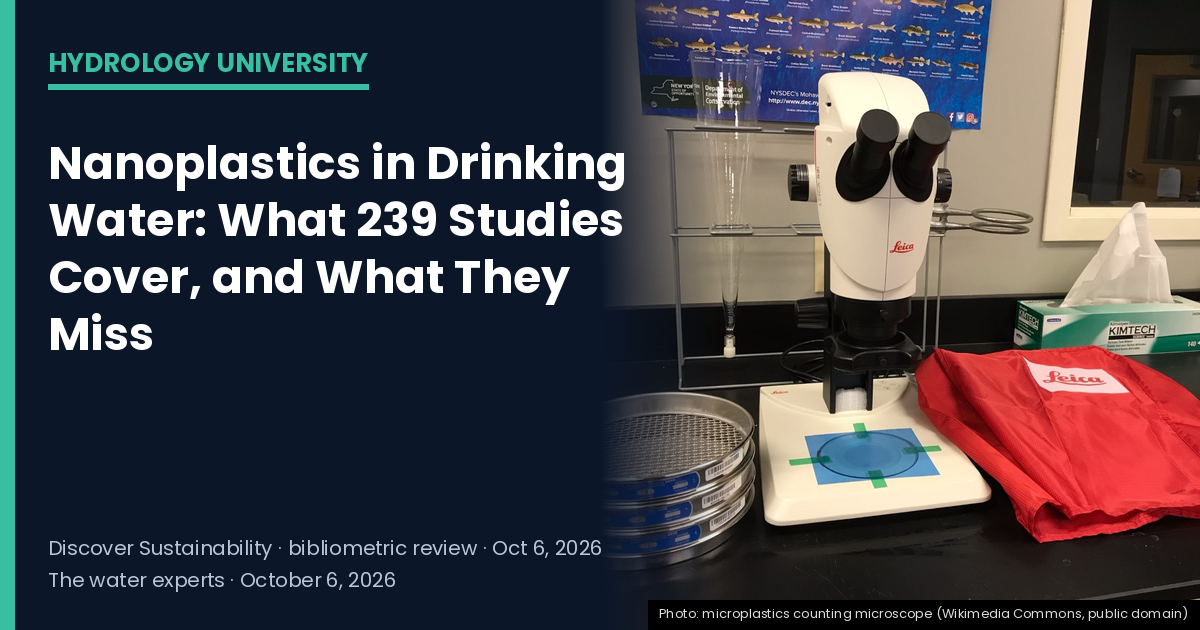
Photo: stereo microscope set up for counting microplastics in water samples (Wikimedia Commons, public domain).
Keep learning with the water experts
- Measurement in action: New UMaine Facility Will Map Microplastics in Maine’s Water, Seafood and Soil
- Treatment in action: Real-Time LIBD Tracks Nanoplastics Deposition on Nanofiltration Membranes
- Want to understand what’s in your own water? Explore our water testing guides.