PFAS Detected at 83% of 1,602 U.S. River, Lake and Stream Sites Tested, New Report Finds
Hydrology University ·
- Current News
- PFAS
- Surface Water
- Testing
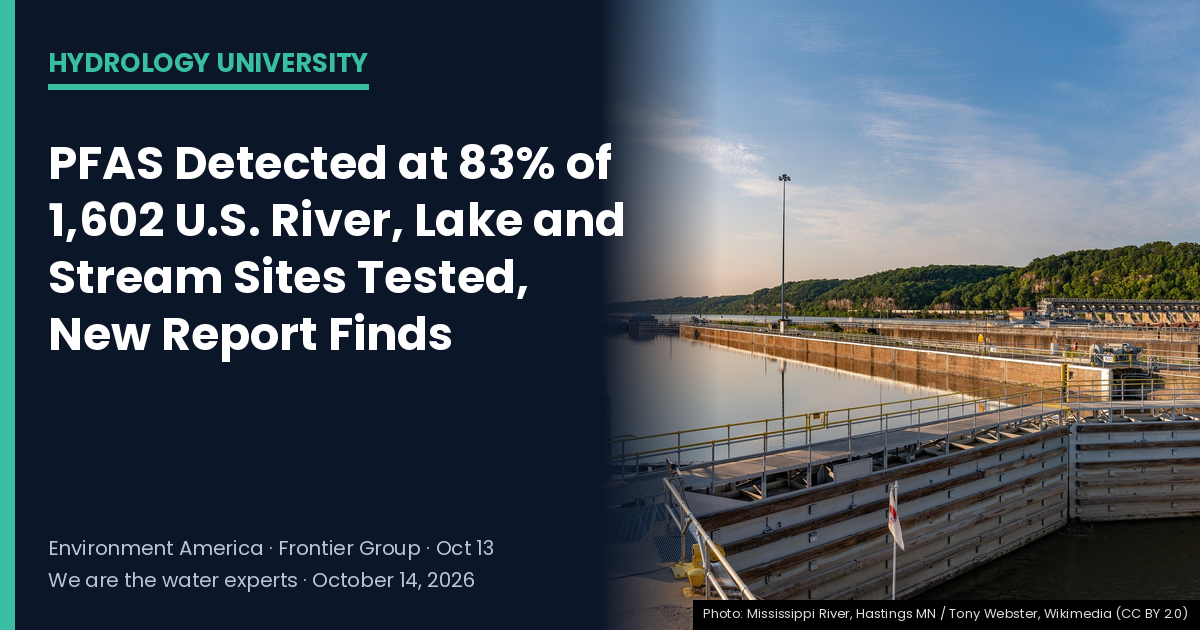
PFAS, the so-called "forever chemicals," turned up at 83% of the river, lake and stream monitoring locations included in a new national analysis. The report, "PFAS found in America's lakes and streams," was released October 13, 2026, by the Environment America Research & Policy Center and Frontier Group. It pulls together federal, state and nonprofit surface-water testing data collected from 2022 through 2024.
We are the water experts. We track nanoplastics and microplastics alongside PFAS, and when a new national data set lands, we want you to know what it measured, what it did not, and what it means for the water you use.
What the report found
- 1,329 of 1,602 locations. PFAS were detected at least once at 1,329 of 1,602 monitored surface-water locations nationwide between 2022 and 2024.
- 114 compounds detected. Across all the data, 174 different PFAS compounds were tested and 114 were detected at least once. Not every location was tested for every compound.
- Mississippi River. PFAS were detected at all 39 Mississippi River monitoring locations in Minnesota and Wisconsin included in the analysis, with 13 compounds found. The highest measured concentration was 23.3 ng/L of PFBA at a location near Hastings, Minnesota.
- Lake Ontario and Tiger Lake. PFAS were detected at every monitored Lake Ontario location (highest: 11 ng/L PFBA) and at all six Tiger Lake, Florida, locations, where 36 compounds were detected (highest quantified: 19 ng/L PFBS).
- Highest results. The top value in the data set came from Brunswick, Maine, after an accidental firefighting-foam (AFFF) release at Brunswick Executive Airport in August 2024. Maine DEP testing found PFOS at 1,040,000 ng/L at the inlet of an affected stormwater retention pond. The report also lists Lake Holloman, New Mexico (PFHxA near 30,000 ng/L, near Holloman Air Force Base).
Massachusetts: 87% of 108 locations
A Massachusetts report from the MASSPIRG Education Fund, Environment Massachusetts Research and Policy Center and Frontier Group found PFAS at 87% of 108 Massachusetts locations tested between 2022 and 2024, from the Charles River and Jamaica Pond to the Connecticut, Chicopee and Hoosic rivers, GBH News reported on October 14, 2026. GBH also noted that the Massachusetts Department of Public Health has issued 64 fish consumption advisories tied to PFAS.
"This is really the tip of the iceberg because we do not test all the waterways," Deirdre Cummings, consumer program director for the MASSPIRG Education Fund, told GBH.
Read the numbers carefully
- This is surface water, not tap water. The analysis excluded records labeled drinking water, groundwater and wastewater. Many rivers and lakes are drinking-water sources, but these results are not measurements of treated water at your tap.
- Detection is not the same as risk. The authors note that PFAS compounds differ in toxicity and that detections and concentrations of different PFAS "should not be interpreted as equivalent measures of health risk."
- The map has gaps. The data come mostly from the national Water Quality Portal (which pulls in EPA and USGS monitoring data), plus Waterkeeper Alliance data and state data from Maine and Massachusetts. Many waterways are never tested, so the authors call their results a subset of existing contamination.
- It is an advocacy report. Environment America and Frontier Group pair the data with policy recommendations, including phasing out many PFAS uses, ending land application of PFAS-laden sewage sludge, and continued surface-water monitoring.
What the water experts recommend
- Know your source. Your utility's annual Consumer Confidence Report shows whether your supply comes from surface water or groundwater and lists contaminants detected in your system.
- On a private well near a known PFAS source (an airport, military base, fire-training site or biosolids field), consider certified-lab PFAS testing.
- Check local fish advisories before eating fish from rivers and lakes; Massachusetts, for example, has issued PFAS-specific advisories.
More from Hydrology University: Illinois Becomes First State to Win EPA's Tentative Approval for PFAS Drinking-Water Primacy · Battery Fire Suppressant Linked to Ultra-Short-Chain PFAS in Long Island Drinking Water Wells · Water testing guides
Sources
- John Rumpler (Environment America Research & Policy Center) and Nilou Yaar (Frontier Group), "PFAS found in America's lakes and streams," October 13, 2026: environmentamerica.org
- Craig LeMoult, "PFAS chemicals are in most Mass. rivers and waterways tested in new report," GBH News, October 14, 2026: wgbh.org
Photo: Lock and Dam No. 2 on the Mississippi River, Hastings, Minnesota, by Tony Webster via Wikimedia Commons (CC BY 2.0). Illustrative view of the river reach named in the report; not a sampling photo.