Augusta, Maine Restores East-Side Well After About $2 Million PFAS Filtration Upgrade
Hydrology University ·
- Current News
- PFAS
- Treatment
- Drinking Water
- Maine
Augusta, Maine, has a concrete example of what meeting a state PFAS limit can look like at the wellhead. After shutting its east-side Riverside wells in late 2024, the Greater Augusta Utility District designed, funded and installed a roughly $2 million filtration system — and has brought that supply back online. Here is what changed, what the latest samples show, and how absorption-based PFAS treatment works, from the water experts at Hydrology University.
What happened in Augusta
- The exceedance. On November 4, 2024, a compliance sample from the two Riverside wells showed a PFAS sum of 23.3 parts per trillion (ppt), above Maine's 20 ppt limit for any one or the sum of six listed PFAS after treatment and before distribution, according to the utility's own public notice and PFAS page.
- The shutoff. The Riverside wells were taken out of service on November 19, 2024. East-side customers were supplied from three Bond Brook / Triangle Station wells farther from the Kennebec River.
- The fix. Central Maine reported on October 9, 2026 that after about a year and a half of design, permitting, grant funding and installation, staff had turned the east-side water back on. The project cost about $2 million, funded through a grant from the Maine Drinking Water Program, and reused an existing building near the well to avoid a new facility.
- How the system works (utility description). Assistant general manager and chief engineer Andy Begin told Central Maine the new system does not "filter PFAS particles out" in the mechanical sense; it absorbs them onto media that are then sent to a landfill for disposal.
- Latest Riverside numbers. On the utility's posted compliance table, a September 11, 2026 sample labeled Riverside Combined (Bonenfant & MainEx) lists ND (not detected) for PFOS, PFOA, PFNA, PFHxS, PFHpA and PFDA, with a sum of ND. Triangle Station samples from 2025–2026 are also shown as ND or near-ND on the same table.
General manager Brian Tarbuck told Central Maine there is "no particular smoking gun" for the river PFAS trend, and that the district is planning an additional west-side well within about two years for redundancy.
Maine's rule, in plain language
Maine set a 20 ppt drinking-water limit (2021) for any one, or the sum, of six PFAS analytes after treatment and before distribution. That is stricter than waiting for every federal timeline alone, and it is why Augusta acted when Riverside hit 23.3 ppt. Federal EPA maximum contaminant levels for PFOA and PFOS are separate and still matter for long-term planning; Augusta had already begun pilot work after EPA's 2023 proposed rule flagged Riverside levels relative to the proposed 4 ppt PFOA/PFOS MCLs.
How absorption-based PFAS treatment works
Utilities use several tools for PFAS. Augusta's team describes an absorption process onto media that later go to disposal. Related approaches you will see elsewhere include:
- Granular activated carbon (GAC). Carbon beds adsorb many longer-chain PFAS such as PFOA and PFOS; shorter-chain compounds often break through sooner (U.S. EPA).
- Ion-exchange resins. Charged resins can preferentially bind PFAS anions; spent resin is typically replaced and managed as a waste stream.
- High-pressure membranes (RO / NF). These can reject a broad PFAS suite but create a concentrated waste stream that still needs management.
Whatever the media, capacity is finite. Utilities monitor treated water and replace or regenerate media on a schedule. Home point-of-use filters are a different scale; EPA publishes consumer guidance for choosing certified devices when people want an extra layer at the tap.
The water experts' take: what this means for you
- On a public system? Read your Consumer Confidence Report and any PFAS notices. Augusta's table is a model of posting dates, analytes and ND results in one place.
- On a private well? State advisories and private-well testing programs (where available) matter more than city plant news. Maine's Drinking Water Program pages are the starting point for state rules.
- Watch the waste side. Absorbing PFAS onto media does not destroy the chemicals. Ask how spent media are handled (landfill, reactivation, destruction).
- Timeline honesty. Augusta had pilot data ready when the exceedance hit — that is why the turnaround was faster than building from a blank page.
A note on scope: this post summarises Greater Augusta Utility District public documents and reporting by Central Maine. It is not medical advice. "PFAS-free" wording in news coverage is attributed to reporting; we use the utility's ND lab results and Maine's 20 ppt standard instead.
Explore more from the water experts: Water testing guides · Greensboro Approves About $260 Million for PFAS Treatment: How Granular Activated Carbon Works · PFAS Above State Limit in Over Half of Tested Tiverton, R.I. Wells
Sources
- Sara Coughlin, "Greater Augusta Utility District completes $2M PFAS filtration project," Central Maine, October 9, 2026: centralmaine.com
- Greater Augusta Utility District, PFAS page (compliance table, Nov 2024 notice, Maine 20 ppt explanation): greateraugustautilitydistrict.org/pfas
- Maine Drinking Water Program, PFAS in public water systems (context): maine.gov DHHS DWP PFAS
- U.S. EPA, "Reducing PFAS in Drinking Water with Treatment Technologies" (GAC / treatment context): epa.gov
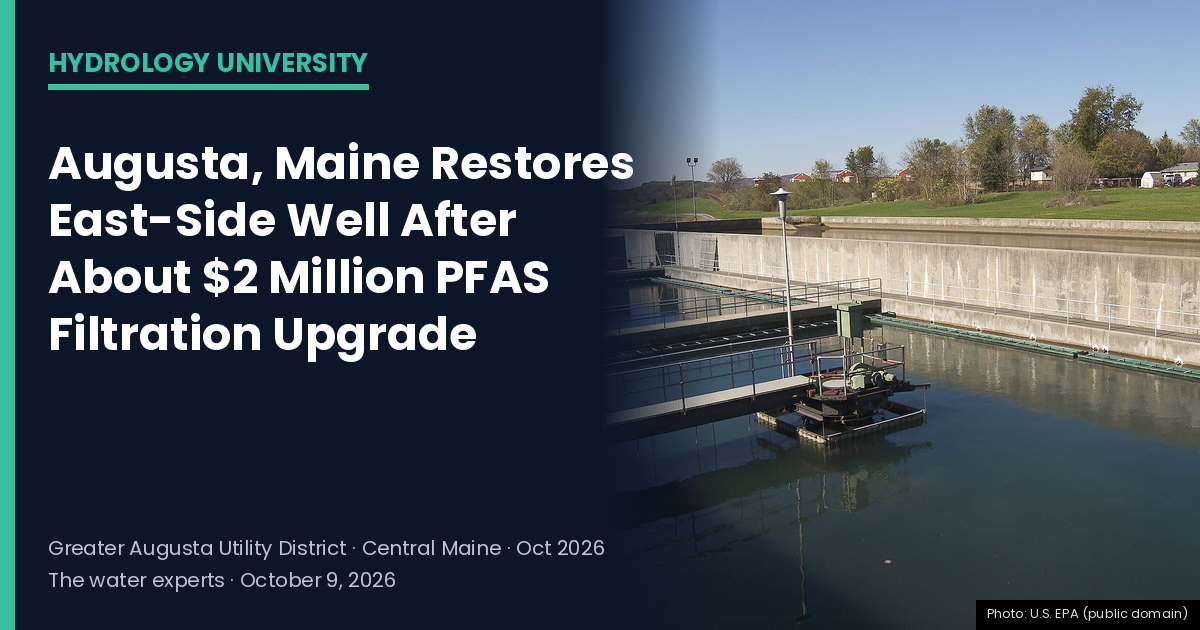
Photo: coagulation and filtration processes at a drinking water treatment plant, U.S. EPA (public domain). Generic treatment illustration; not the Augusta Riverside station.