PFAS Above State Limit in Over Half of Tested Tiverton, R.I. Wells: What Well Owners Should Know
Hydrology University ·
- Current News
- PFAS
- Private Wells
- Testing
- Drinking Water
More than half of the private wells tested so far in one Rhode Island neighbourhood have PFAS above the state's drinking-water standard. Here is what state and town officials have reported about the Tiverton investigation, and what the water experts at Hydrology University want every private well owner to take from it.
What officials have found
The Rhode Island Department of Environmental Management (RIDEM) is investigating private wells around the Crandall Road area of Tiverton, R.I., under a targeted, EPA-funded program that samples private wells near potential PFAS sources such as fire stations and landfills.
- 101 of 184 wells over the limit. Of the 184 wells with available test results, 101 exceeded Rhode Island's standard of 20 parts per trillion (ppt), a RIDEM spokesperson told The Brown Daily Herald (reported October 6, 2026).
- About 110 contaminated wells as of Oct. 1. The Town of Tiverton's weekly update (dated October 4, 2026) says RIDEM reported approximately 110 contaminated private wells as of Thursday, October 1, and that testing and some retesting are continuing.
- Very high readings at a few homes. As of September 16, seven homes tested above 1,600 ppt, and one well reached roughly 4,000 ppt, which RIDEM described as the highest level ever recorded in a private well in Rhode Island (per the Herald).
- Source not yet confirmed. RIDEM told the Herald the source of the contamination has not been confirmed. Town Council Vice President David Paull told the Herald that a fire station sits near the affected wells, and that the area also includes former farmland and old landfills.
What's being done
- Treatment systems. RIDEM is installing filtration systems in homes whose wells test between 20 and 1,600 ppt, at a pace of about 10 installations per week, according to the town update.
- A new water line. Wells above 1,600 ppt cannot be handled with standard filtration systems, according to RIDEM, so the North Tiverton Fire District is extending a public water line. The district received a $1 million USDA Emergency Community Water Assistance grant, and the town reports two Phase 1 construction bids, one just under $1 million and one about $1.2 million. The stated goal is to have the line operating before the first snowfall of 2026.
- Bottled water. The town is delivering water to affected residents until their systems are verified as installed and working.
- Next community meeting. The town is looking at the week of October 26, potentially Wednesday, October 28 at Tiverton High School.
Why neighbours can get very different results
The Rhode Island Department of Health (RIDOH) explains it simply: in Rhode Island's bedrock aquifer, wells draw water from cracks in the rock. Those cracks are uneven, and wells can be drilled to different depths, so two neighbours can have very different PFAS results. That is exactly why testing each well matters.
The water experts' take: if you're on a private well
Public water systems are tested under federal and state rules. Private wells usually aren't, unless the owner arranges it. Tiverton is a reminder that a well can look, smell and taste normal and still carry PFAS.
- Know your state's standard. Rhode Island's standard is 20 ppt for the combined total of six PFAS. Other states and the EPA use different numbers, so check your own state's rules.
- Use a certified laboratory. RIDOH says well water should be tested at a state-certified laboratory rather than with over-the-counter or at-home kits. In Rhode Island, the State Laboratory offers PFAS testing at $200 per sample, and results typically take about 15 business days.
- Ask about free testing near known sources. Inside Tiverton's investigation area, RIDEM offers free private-well tests. Elsewhere, ask your state environmental or health agency whether a testing program covers your area.
- Follow official guidance on use. RIDOH says only a small amount of PFAS gets into the body through skin, so showering, bathing and washing dishes are unlikely to significantly increase risk. For drinking and cooking, follow your health department's advice for your result.
- Retest and keep records. RIDEM has retested several Tiverton wells. Keep every lab report so you can track changes over time.
Tiverton residents: RIDEM private-well testing in the investigation area: ridem.ecsdc@dem.ri.gov. RIDOH Private Wells Program: 401-222-6867. State Lab sample bottles: 401-222-6064. Town updates: tiverton.ri.gov/363/PFAS-Information.
A note on scope: this post summarises public statements from Rhode Island agencies and the Town of Tiverton. It is not medical advice. Contact your state health department about your own well results.
Explore more from the water experts: Water testing guides · Nanoplastics in Drinking Water: What 239 Studies Cover, and What They Miss
Sources
- Town of Tiverton, "PFAS Update / Crandall Road Area: Key Updates & Next Steps," dated October 4, 2026 (posted October 5): tiverton.ri.gov/363/PFAS-Information
- Rhode Island Department of Health, "Tiverton: PFAS and Drinking Water: Frequently Asked Questions": health.ri.gov (PDF)
- Rhode Island Department of Environmental Management, PFAS in Water: dem.ri.gov/environmental-protection-bureau/water-resources/pfas
- Dhruv Jain, "Over half of tested Tiverton wells contain 'forever chemicals' well above state limit," The Brown Daily Herald, October 6, 2026 (RIDEM figures): browndailyherald.com
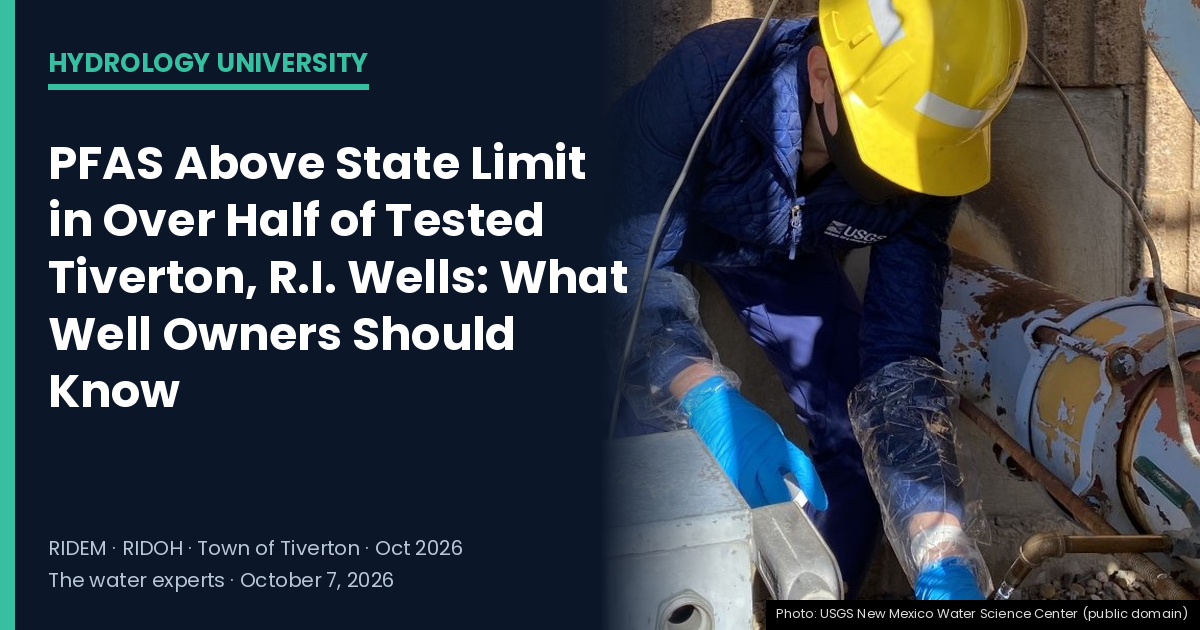
Photo: a USGS scientist collecting a groundwater sample for PFAS analysis, U.S. Geological Survey New Mexico Water Science Center (public domain).