Greensboro Approves About $260 Million for PFAS Treatment: How Granular Activated Carbon Works
Hydrology University ·
- Current News
- PFAS
- Treatment
- Activated Carbon
- Drinking Water
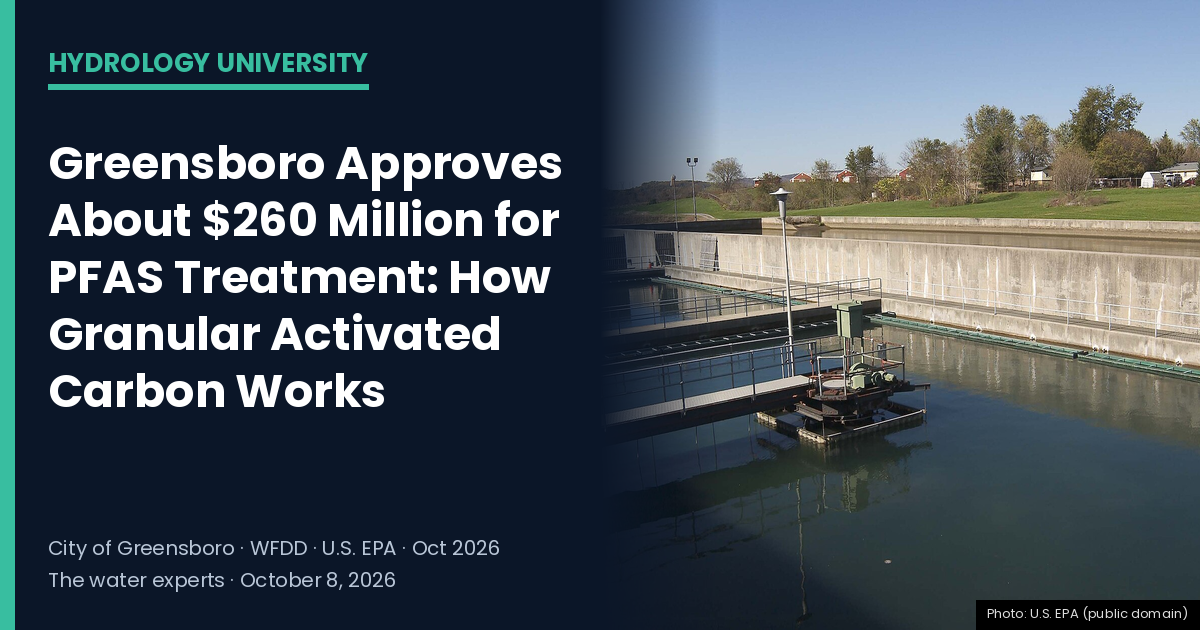
Greensboro, North Carolina, has committed to one of the biggest PFAS treatment upgrades in the Southeast. Here is what the city approved, what it is building, and how the treatment it chose, granular activated carbon, actually works, explained by the water experts at Hydrology University.
What Greensboro approved
- About $260 million for the Mitchell plant. On Tuesday, October 6, 2026, Greensboro City Council unanimously approved funding to upgrade the Mitchell Water Treatment Plant's system for treating PFAS. The city will pay The Haskell Company roughly $260 million for the work, 88.5 WFDD reported on October 7.
- $338 million across two plants. Water Resources Director Mike Borchers told WFDD that upgrading both the Mitchell and Townsend water treatment plants will cost $338 million in total, with improvements set to be completed by 2029. The city's own project page lists Townsend's completion as 2029/2030 and notes that schedules may change with regulatory requirements and deadlines.
- Why. Testing has shown PFAS in Greensboro's drinking water sources, including Lake Brandt and Lake Townsend, WFDD reported. City documents say Greensboro currently has interim measures in place to treat the water, but that these "are not long-term solutions."
What's being built
According to the City of Greensboro, both projects install granular activated carbon (GAC) contactors to help the city meet the U.S. EPA's enforceable PFAS limits (maximum contaminant levels) under the National Primary Drinking Water Regulation.
- Mitchell: a new pump station and GAC treatment, a dual-media treatment system, reconfigured flocculation and sedimentation basins, and a new backwash treatment basin for residuals (the solids that form during treatment), delivered by a construction manager at risk.
- Townsend: a GAC pump station, GAC contactors and large-diameter piping, delivered by a design-build team (Crowder/CDM Smith) under a contract the council approved in March 2026.
- Regionally: the Piedmont Triad Regional Water Authority plans reverse-osmosis advanced treatment for emerging contaminants at its John F. Kime plant at Randleman Lake, with construction scheduled from fall 2027 through fall 2031.
How granular activated carbon works
Borchers described the Mitchell system to council as "really large concrete basins" filled with "basically 15 feet of activated carbon," with the water trickling through. He said the city's testing shows it is a very effective technology, bringing PFAS down to near non-detect levels.
The science behind that, from the U.S. EPA:
- It's adsorption, not straining. Activated carbon is made from carbon-rich materials such as wood, lignite and coal. It is highly porous, so it offers a huge surface area that PFAS molecules stick to as water flows through.
- It works best after particles are out. EPA notes GAC performs well in a flow-through filter after particulates have already been removed, which is why it sits after conventional treatment steps.
- Performance depends on the details. EPA researcher Thomas Speth says GAC "can be 100 percent effective for a period of time," depending on the type of carbon, the depth of the carbon bed, the water's flow rate, the specific PFAS, temperature, and the organic matter and other substances in the water.
- Chain length matters. GAC works well on longer-chain PFAS such as PFOA and PFOS, while shorter-chain PFAS such as PFBS and PFBA do not adsorb as well, according to EPA. That's one reason some utilities look at alternatives such as ion exchange or reverse osmosis.
- Carbon gets used up. Because performance holds "for a period of time," utilities monitor treated water and replace or reactivate the carbon on a schedule.
The water experts' take: what this means for you
- On city water? Your utility's annual water quality report (Consumer Confidence Report) is the place to see what's been detected and what's planned. Greensboro posts PFAS updates on its Water Resources pages.
- Know the timeline. Big plant upgrades take years. If you want to know your own level now, ask your utility for its latest PFAS sampling results.
- Considering a home filter? Look for independent certification for the specific PFAS you care about (for example, PFOA and PFOS), not just a general "carbon filter" label, and follow the replacement schedule, because carbon has a limited capacity.
A note on scope: this post summarises public statements and documents from the City of Greensboro, reporting by 88.5 WFDD, and U.S. EPA research. It is not medical advice.
Explore more from the water experts: Water testing guides · PFAS Above State Limit in Over Half of Tested Tiverton, R.I. Wells
Sources
- Rachel Moody, "GSO City Council approves $260M to treat PFAS in drinking water," 88.5 WFDD, October 7, 2026: wfdd.org
- City of Greensboro Water Resources, "Drinking Water Supply Treatment Projects": greensboro-nc.gov
- City of Greensboro, Resolution 2026-48 background memo, Mitchell WTP Residuals and Emerging Contaminants Improvements (interim measures): pub-greensboro-nc.escribemeetings.com
- U.S. EPA, "Reducing PFAS in Drinking Water with Treatment Technologies": epa.gov
Photo: coagulation and filtration processes at a drinking water treatment plant, U.S. EPA (public domain).