FIU Researchers Say New Lab Method Cuts PFAS Testing Time From Over Six Hours to 30 Minutes
Hydrology University ·
- Current News
- PFAS
- Testing
- Florida
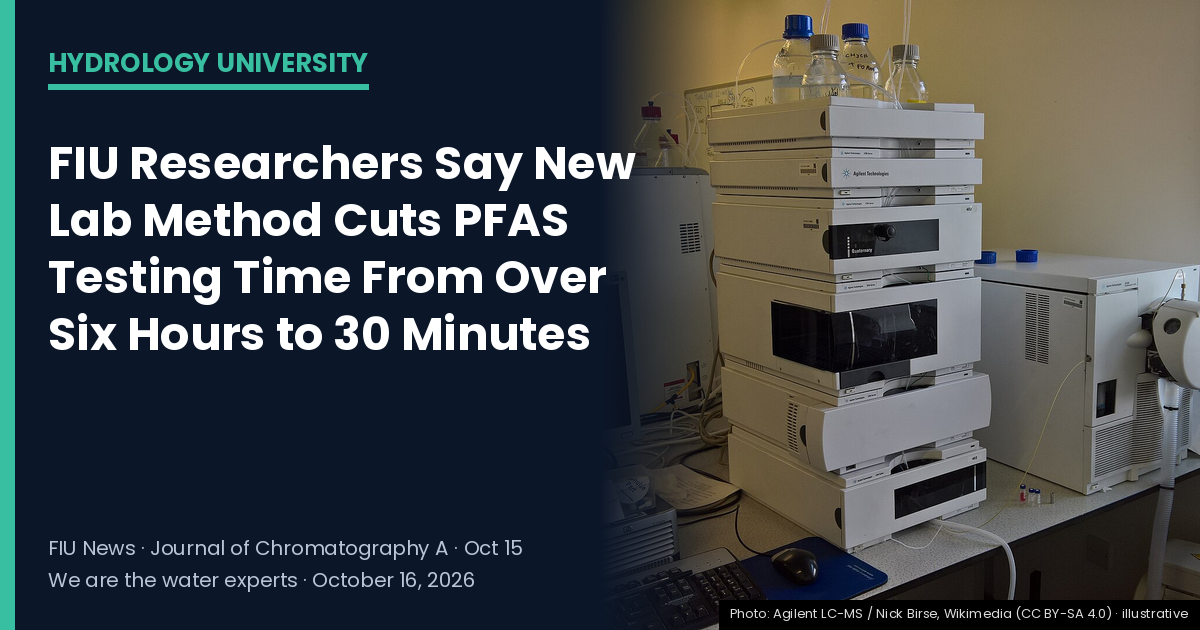
Researchers at Florida International University (FIU) say they have developed a faster, more efficient method to detect PFAS, often called forever chemicals, in water, cutting testing time from over six hours to just 30 minutes, according to an FIU News release dated October 15, 2026. The findings were published in the Journal of Chromatography A.
We are the water experts. When a lab method could change how quickly utilities track forever chemicals, we want you to know what it does, what FIU reported, and what still has to happen before water systems can use it.
What FIU reported
- 30 minutes instead of 6+ hours. The method automates sample cleanup using online solid-phase extraction paired with high-precision testing tools to measure tiny traces of PFAS, FIU said.
- Smaller samples, less solvent. By using smaller samples and less solvent, the method reduces the risk of human handling errors, according to FIU.
- 39 of 40 compounds. The method detects 39 of the 40 EPA-listed PFAS compounds. The team intentionally left one compound out because tracking it would have meant raising the detection limits for the two most regulated PFAS, which associate professor Natalia Quinete called an unacceptable compromise.
- Small and large molecules together. FIU said the method analyzed both small and large PFAS molecules at once, and the team is now working to detect even smaller molecules.
Why speed matters in South Florida
FIU points to South Florida, where drinking water is sourced from the shallow Biscayne Aquifer, which FIU describes as vulnerable to surface runoff from landfills, airports, a military airbase and rainwater contamination. In Miami-Dade County, groundwater wells are monitored for PFAS every four months, and the county is working to keep wells with higher levels out of the main water supply, postdoctoral associate Maria Guerra de Navarro said.
FIU also notes that many utilities are investing in activated carbon, reverse osmosis and nanofiltration membranes, and that these systems do not destroy PFAS; they concentrate the chemicals into a separate waste stream that can be difficult to dispose of safely.
Under EPA's 2024 PFAS drinking-water rule, public water systems must complete initial PFAS monitoring by 2027 (EPA).
“I believe the EPA should consider incorporating this type of technology into a standard method, given the enormous national demand for PFAS monitoring under new drinking water regulations,” Guerra de Navarro said in the FIU release.
Read the announcement carefully
- Not certified yet. FIU says that before the rapid method can be widely used by water facilities, it must be certified, which requires extensive validation studies across multiple independent laboratories.
- Aimed at water facilities. FIU says the method could significantly improve how water facilities track PFAS by speeding up the process.
- This is a methods study, not a new tap-water survey. FIU's team has separately characterized PFAS in tap water across multiple areas of Miami-Dade County, but the release does not report those results.
- Next steps. The team is developing a simpler method to measure total PFAS that could process 20 samples in a single day, and is expanding into PFAS in human serum samples, FIU said.
Faster detection: nanoplastics too
Speeding up detection is also a theme in nanoplastics research. See our earlier story on self-floating glass microbubbles that capture nanoplastics in 10 minutes for faster detection. The FIU method covers PFAS only; it does not test for nanoplastics or microplastics.
What the water experts recommend
- Watch your utility's water-quality reports. EPA says public water systems must provide the public with information on the levels of regulated PFAS in their drinking water beginning in 2027 (EPA).
- On a private well? EPA's PFAS drinking-water rule sets requirements for public water systems. If you want your well tested for PFAS, use a state-certified drinking-water laboratory.
More from Hydrology University: San Jose Water's Planned Ion-Exchange PFAS Plant Highlighted by California Regulators as a Model · PFAS Detected at 83% of 1,602 U.S. River, Lake and Stream Sites Tested, New Report Finds · Water testing guides
Sources
- Michelle Marie Arean, “30 minutes to detect PFAS: FIU's new water safety breakthrough,” FIU News, Florida International University, October 15, 2026: news.fiu.edu
- U.S. EPA, “Per- and Polyfluoroalkyl Substances (PFAS)” (April 10, 2024 final rule; initial monitoring and public information on PFAS levels by 2027): epa.gov
Photo: An Agilent LC-MS laboratory system, by Nick Birse via Wikimedia Commons (CC BY-SA 4.0); cropped, headline added in the featured image. Illustrative lab instrument; not FIU's equipment.