Navy to Connect Whidbey Island Building to City Water After PFAS Found in Private Well, News-Times Reports
Hydrology University ·
- Current News
- PFAS
- Private Wells
- Washington
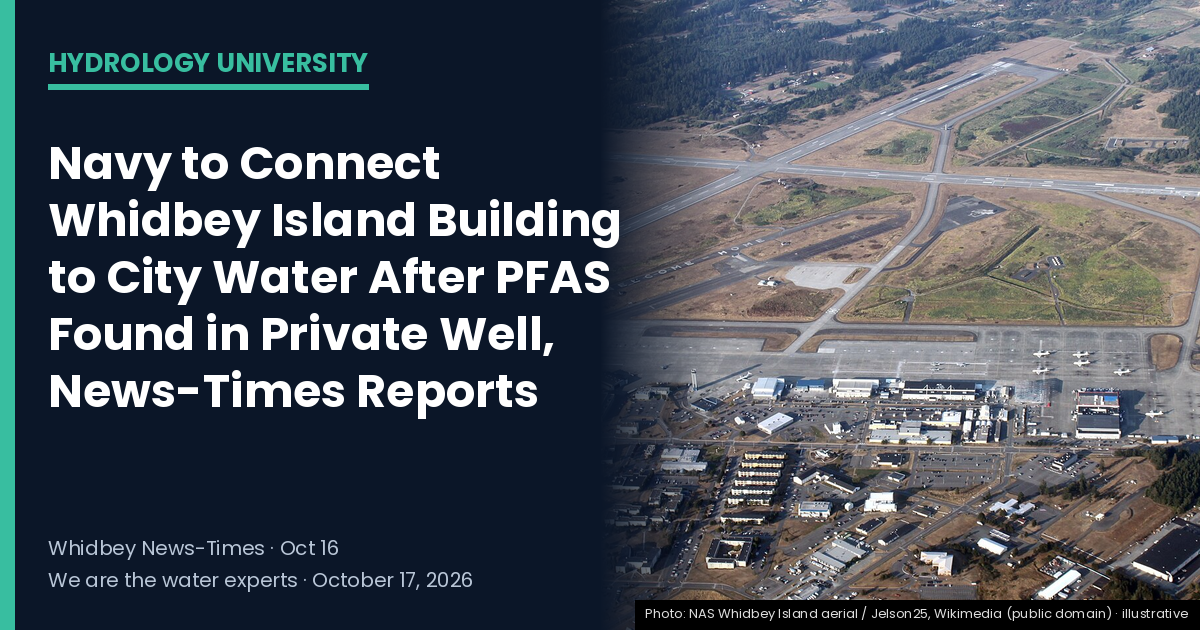
The U.S. Navy plans to connect a North Whidbey Island, Washington, building to Oak Harbor's municipal water system after tests found PFAS, often called forever chemicals, in the building's private drinking water well, the Whidbey News-Times reported on October 16, 2026.
We are the water experts. When PFAS turns up in a private well, we want you to know what was found, what the Navy plans to do and how the reported levels compare with the federal limit.
What the Navy reported
- Levels found. PFAS concentrations ranging from 5.80 to 6.26 parts per trillion were detected in the well in fall 2025 and spring 2026, according to the Naval Facilities Engineering Systems Command (NAVFAC) Northwest public affairs office. The News-Times reported that the maximum contaminant level allowed by the U.S. EPA in this case is 4 parts per trillion.
- Location kept private. The well is within the Area 6 Landfill drinking water sampling area; NAVFAC declined to give more detail about its location to protect the owner's privacy.
- A faster track. An action memorandum dated Sept. 15 and signed Sept. 22 by Naval Air Station Whidbey Island Commanding Officer Capt. Nathan Gammache starts a time-critical action for the well. Time-critical actions address PFAS faster than non-time-critical actions, which require months of planning before implementation, the News-Times reported.
- Cost and timeline. The Navy expects to spend about $120,000 to install about 150 linear feet of distribution piping and water supply pumping improvements for the waterline connection, according to the memorandum. Full implementation could take about a year, the News-Times reported.
- After the hookup. Once the action is complete, the well's owner will decide whether it is kept for non-potable uses, NAVFAC said.
- Second case since September 2025. This is the second time-critical action the Navy has started since Sept. 2025; the first connected a North Whidbey home to the Navy's waterline earlier this year.
Background
The News-Times reported that off-base drinking water wells on Whidbey have been sampled since EPA released lifetime health advisories for two types of PFAS about a decade ago. Historically, the Navy used foam containing PFAS to fight fires on the base, and the substances now contaminate groundwater on the base and some nearby wells, according to the newspaper.
Public comment is open
A public comment period on the Navy's plan for this well is open until Oct. 30. Comments can be emailed to navfacnwpaco@us.navy.mil or mailed to NAVFAC Northwest's public affairs officer, the News-Times reported.
Read the report carefully
- One private well. The report covers a single private well serving one building; its exact location was not disclosed.
- Compound not named. The News-Times did not say which PFAS compound or compounds were measured. EPA's 2024 rule sets limits of 4.0 parts per trillion each for PFOA and PFOS, with compliance determined by running annual averages at the sampling point (EPA).
- Public systems vs. private wells. EPA's PFAS drinking-water rule sets requirements for public water systems. EPA says it also announced $1 billion in funding to help states and territories with PFAS testing and treatment at public water systems and to help owners of private wells address PFAS contamination (EPA).
What the water experts recommend
- On a private well? EPA's PFAS drinking-water rule sets requirements for public water systems. If you want your well tested for PFAS, use a state-certified drinking-water laboratory.
- Live near NAS Whidbey Island? The News-Times says more information about the Navy's PFAS cleanup on the island is posted at pacific.navfac.navy.mil/NASWIPFAS.
More from Hydrology University: PFAS Above State Limit in Over Half of Tested Tiverton, R.I. Wells: What Well Owners Should Know · FIU Researchers Say New Lab Method Cuts PFAS Testing Time From Over Six Hours to 30 Minutes · Water testing guides
Sources
- Allyson Ballard, “Contaminated well prompts Navy water project,” Whidbey News-Times, October 16, 2026: whidbeynewstimes.com
- U.S. EPA, “Per- and Polyfluoroalkyl Substances (PFAS)” (April 10, 2024 final rule; PFOA and PFOS limits; funding for public systems and private wells): epa.gov
Photo: Aerial view of Naval Air Station Whidbey Island, Washington, by Jelson25 via Wikimedia Commons (public domain); cropped, headline added in the featured image. Illustrative; not the well site.